Why Every Child Needs a Spinal Checkup | Pediatric Chiropractor San Antonio
Dr. Dan Foss explains why children's spinal checkups are as important as dental and vision exams at Pura Vida Chiropractic in San Antonio TX.

On this page
Let me ask you a question: when was the last time your child had their eyes checked? Their teeth cleaned? Their hearing tested? If you are like most parents in San Antonio, the answer is within the last year. Schools require vision and hearing screenings. Pediatricians recommend dental visits every six months. These checkups are routine, expected, and unquestioned.
Now let me ask you another question: when was the last time your child had their spine checked?
If you hesitated — or if the answer is "never" — you are not alone. Most parents do not even know that pediatric spinal checkups exist. And that is a problem, because your child's spine is arguably more important than their teeth, their eyes, and their ears combined.
I am Dr. Dan Foss, and I have been treating children from birth through their teenage years for over 23 years at Pura Vida Chiropractic in San Antonio. I am Advanced SOT certified through SORSI with specialized training in pediatric chiropractic care. And I am here to tell you that a spinal checkup should be as routine as a dental cleaning — because what your child's spine protects is their lifeline.
Your Child's Spine Is Their Lifeline
Your child's spinal cord carries billions of nerve fibers that connect their brain to every organ, tissue, muscle, and cell in their body. It is the information superhighway of their entire existence. Every heartbeat, every breath, every thought, every movement, every immune response — it all depends on clear, uninterrupted communication through the spinal cord.
When that communication is disrupted by vertebral subluxations — misalignments in the spine that put pressure on nerves — the result is not just back pain. The result is dis-ease: a state where the body is not functioning at its full potential. In children, this can manifest as:
- Weakened immune function — getting sick more often than other children
- Digestive problems — constipation, stomach aches, colic in infants
- Sleep disturbances — difficulty falling asleep, restless sleep, night terrors
- Behavioral changes — hyperactivity, difficulty concentrating, mood swings
- Developmental delays — in crawling, walking, or other milestones
- Chronic ear infections, sinus congestion, and respiratory issues
These are not problems that most parents associate with the spine. But when you understand that the nervous system controls everything, it becomes clear that spinal health is total body health.
Warning Signs That Your Child May Have Subluxations
As a parent, you see your child every day. You know their patterns, their habits, their quirks. Some of what you see as normal may actually be signs that their spine needs attention. Here are the warning signs I tell every parent in Castle Hills, Stone Oak, Alamo Heights, Leon Valley, Helotes, Shavano Park, and Boerne to watch for:
One hip or shoulder noticeably higher than the other. Stand behind your child and look at their shoulders and hips. If one side is higher, their pelvis or spine may be misaligned. This creates uneven stress on the spine and the nervous system.
Hyperactivity and inability to sit still. While some degree of energy is normal for children, persistent hyperactivity can indicate that the nervous system is stuck in a fight-or-flight state due to upper cervical subluxation.
Frequent falling or clumsiness beyond their developmental stage. Children who fall more often than their peers or seem unusually clumsy may have balance issues related to upper cervical subluxation affecting the vestibular system.
One foot turned in or out when walking. This can indicate pelvic misalignment that is altering gait mechanics. Left uncorrected, it can lead to hip, knee, and ankle problems as the child grows.
Head consistently tilted to one side. In infants, this may be torticollis related to birth trauma. In older children, it often indicates cervical subluxation.
One leg appearing shorter than the other. Functional leg length inequality is one of the primary indicators I use in SOT assessment. It reveals pelvic and spinal misalignment that may not be visible to the untrained eye.
Chronic fatigue or low energy. Children should have abundant energy. If your child seems unusually tired, their nervous system may be working against structural resistance created by subluxation.
Noisy or popping joints. Joints that click, pop, or crack regularly in a child may indicate hypermobility caused by ligament weakness related to spinal imbalance.
Recurring headaches. Children should not have headaches. Recurring headaches in children are frequently caused by subluxations in the upper cervical spine.
Skin conditions such as eczema or chronic rashes. The skin is the body's largest organ and is regulated by the nervous system. Chronic skin conditions can indicate nerve interference affecting the body's ability to regulate immune and inflammatory responses.
Allergies and chronic congestion. The nerves that regulate immune function and sinus drainage exit the upper cervical and upper thoracic spine. Subluxations here can compromise both systems.
Frequent colds, flu, and respiratory illness. A child who catches every bug that goes around may have a compromised immune system related to spinal nerve interference.
Asthma and breathing difficulties. The nerves supplying the lungs and bronchial tubes originate in the cervical and thoracic spine. Subluxations in these areas can contribute to respiratory problems.
Chronic ear infections. This deserves special attention because it affects so many children in San Antonio and across the country.
The Ear Infection Connection: Research That Changes Everything
A landmark study published in the Journal of Clinical Chiropractic Pediatrics (Vol. 2, No. 2, 1997) examined 332 children with chronic ear infections who received chiropractic care. The results were remarkable: 80 percent of the children who had been suffering from chronic ear infections had no more ear infections after beginning chiropractic treatment.
Eighty percent. Without antibiotics. Without ear tubes. Without surgery.
How is this possible? The answer lies in anatomy and neurology. The eustachian tubes — the drainage channels that connect the middle ear to the throat — are regulated by nerves that exit the upper cervical spine. When subluxations in this region interfere with those nerves, the eustachian tubes cannot drain properly. Fluid accumulates in the middle ear. Bacteria grow. Infection develops.
The standard medical approach is to prescribe antibiotics (which kill bacteria but do not address the drainage problem) or to surgically insert ear tubes (which provide artificial drainage but do not address the nerve interference). Both approaches treat the symptom without addressing the cause.
The chiropractic approach corrects the upper cervical subluxation, restores proper nerve function to the eustachian tubes, and allows natural drainage to resume. When the fluid can drain normally, infections stop recurring — because the environment that allowed bacteria to thrive has been eliminated.
I have treated hundreds of children with chronic ear infections over my 23-year career, and the results consistently align with this research. Parents who were told their child needed tubes are often amazed when a few gentle cervical adjustments resolve the problem entirely.
How I Examine and Treat Children
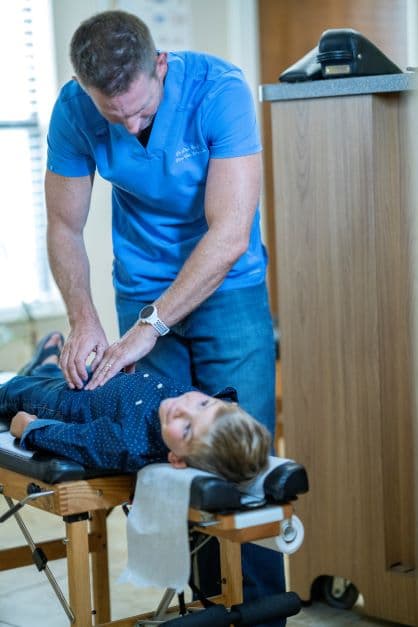
I understand that bringing your child to a chiropractor for the first time can feel unfamiliar. Many parents worry that chiropractic adjustments for children involve the same forces used on adults. They do not. Not even close.
Pediatric SOT adjustments are measured in grams of pressure. To put that in perspective, the force I use on an infant is less than the pressure you would use to test whether a peach is ripe. The force I use on a toddler is about the same as pressing a doorbell. For school-age children and teenagers, the forces increase slightly but remain far gentler than adult adjustments.
There is no twisting. No cracking. No popping. The adjustments are so gentle that infants often sleep through them, and older children typically describe them as "just a little push."
My examination process for children follows the SOT protocol adapted for pediatric patients:
Health history. I talk with parents about their child's birth history, developmental milestones, current symptoms, and any concerns. Birth trauma is one of the most common causes of subluxation in children, so I ask detailed questions about the delivery.
Postural assessment. I observe the child standing, sitting, and walking. I look for the warning signs described above — uneven shoulders, head tilt, gait abnormalities, and other indicators of spinal misalignment.
Palpation. I gently feel along the child's spine to identify areas of muscle tension, joint restriction, and subluxation. Children's spines are remarkably different from adult spines — they are more flexible, more resilient, and respond much faster to correction.
SOT indicators. I use specific SOT diagnostic tests adapted for children, including leg length analysis and pelvic balance checks, to determine the child's SOT category and create an individualized correction plan.
Gentle correction. Based on my findings, I perform precise, gentle adjustments using fingertip pressure. Each adjustment is targeted to the specific subluxation identified during the examination.
The entire first visit typically takes about 30 minutes. Follow-up visits are shorter. And children almost always enjoy the experience — many of my young patients look forward to their visits and remind their parents when it is time to come back.
When Should Children First Be Checked
I recommend that children have their first spinal checkup as early as possible — ideally within the first few weeks of life. The birth process, even under the best circumstances, places significant stress on an infant's spine. Early detection and correction of subluxations can prevent years of silent nerve interference.
After that, I recommend checkups at key developmental milestones:
- When the baby starts holding their head up
- When they begin sitting independently
- When they start crawling
- When they take their first steps
- When they start school (the backpack and desk sitting begin)
- At the beginning of each school year
- After any significant fall or injury
- When participating in sports
Think of it this way: you check your child's teeth every six months because cavities develop silently. You should check your child's spine at least as often because subluxations develop silently too — and the stakes are higher.
Building Strong Children Instead of Repairing Broken Adults
There is a truth I come back to again and again in my practice: it is easier to build strong children than to repair broken adults. The habits and the structural foundation you give your children now will determine their health for the rest of their lives.
A child who grows up with regular spinal checkups develops proper alignment, strong postural habits, and a nervous system that functions at full capacity. That child is less likely to develop chronic pain, degenerative disc disease, chronic illness, and the cascade of health problems that plague so many adults who never had their spines cared for during childhood.
I have been treating entire families — from newborns to grandparents — across Castle Hills, Stone Oak, Alamo Heights, Leon Valley, Helotes, Shavano Park, and Boerne for over 23 years. The families who bring their children for regular checkups consistently report that their kids are healthier, miss less school, need fewer medications, and have more energy than their peers.
That is not a coincidence. That is what happens when the nervous system is free to do what it was designed to do.
Frequently Asked Questions
At what age can children start chiropractic care?
Children can be checked from birth. In fact, newborn checkups are some of the most important because birth trauma is one of the leading causes of subluxation in children. The adjustments for infants are extraordinarily gentle — using only fingertip pressure measured in grams. I have treated babies as young as hours old when parents noticed something was not quite right after delivery.
Is pediatric chiropractic care covered by insurance?
Many insurance plans cover chiropractic care for children just as they cover it for adults. Our office at Pura Vida Chiropractic can verify your benefits before your visit. We also offer a complimentary initial evaluation so you can learn what your child needs before committing to a care plan.
How do I know if my child needs a spinal checkup versus just growing pains?
"Growing pains" is a term that gets used to dismiss legitimate symptoms. While some discomfort during growth spurts is normal, recurring pain, postural asymmetry, chronic illness, behavioral issues, and the warning signs listed in this article warrant a professional spinal evaluation. A free evaluation takes the guesswork out of it — I can tell you exactly what is going on and whether your child would benefit from care.
Ready to Experience Natural Healing? Book Your Free Evaluation
Pura Vida Chiropractic 2318 NW Military Hwy #103, San Antonio, TX 78231 📞 (210) 685-1994 🕐 Mon/Tue/Thu: 7:00 AM – 4:00 PM 👉 Book Free Evaluation