The 3 Phases of Spinal Degeneration: What Stage Is Your Spine In?
Spinal degeneration progresses through 3 phases — and most people don't feel it until Phase 2 or 3. Dr. Dan Foss in San Antonio explains each stage and what can still be done at every level.

On this page
Here is something that surprises most of my patients when they see it on their X-rays for the first time: spinal degeneration does not happen overnight, and by the time it produces symptoms you can feel, it has usually been progressing silently for years — sometimes decades.
In my 23 years of chiropractic practice in San Antonio, one of the most common questions I get after showing patients their spinal imaging is: "How long has this been going on?" The answer is almost always much longer than they expected.
Spinal degeneration progresses through three distinct phases. Understanding which phase you are in — and what can still be done about it — is one of the most important things you can learn about your long-term health.
What Causes Spinal Degeneration
Before we walk through the phases, you need to understand what drives the process. Spinal degeneration is not caused by aging. If it were, every disc and every vertebra in your spine would degenerate at the same rate. But that is never what we see. Degeneration occurs at specific segments — and those segments are always the ones that have lost normal movement and alignment.
The process starts with vertebral subluxation — a condition where one or more vertebrae lose their proper position and normal range of motion. This can happen from a car accident, a fall, a sports injury, years of poor posture, or even the birth process itself. Subluxations are almost always painless in their early stages. You cannot feel them developing. By the time they produce noticeable symptoms, structural damage has already begun.
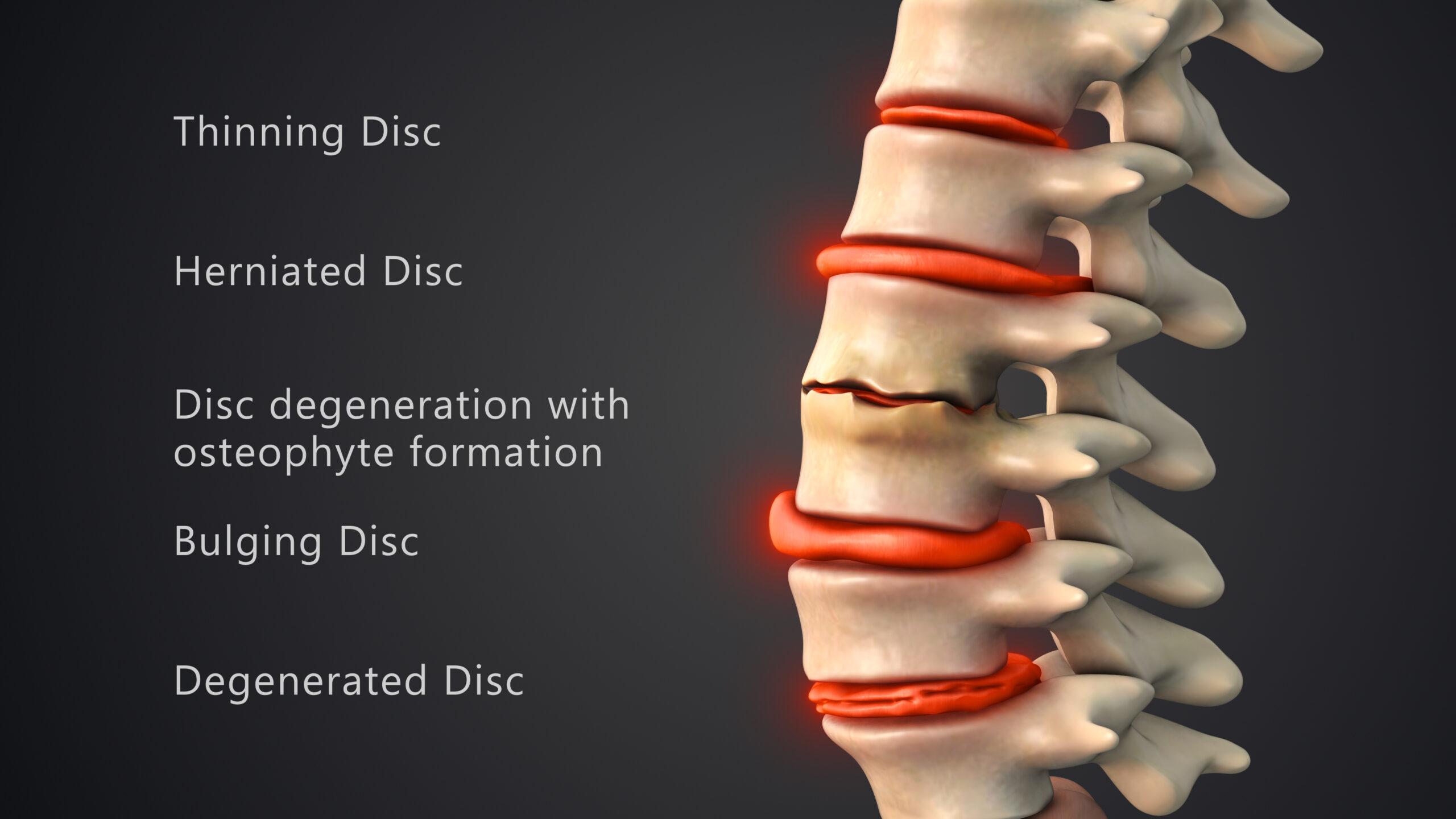
When a spinal segment is subluxated, the disc between the vertebrae loses its normal loading pattern. Portions of the disc become compressed while other portions become unloaded. Over time, this uneven stress causes the disc to thin, bulge, or herniate. The vertebral bones themselves begin to remodel in response to the altered mechanics — producing bone spurs, rough surfaces, and irregular shapes.
This is degeneration. And it follows a predictable progression.
Phase 1: Loss of Normal Curve and Early Dysfunction
In Phase 1, the most obvious finding is a loss of the normal spinal curve. A healthy cervical spine (neck) has a gentle forward curve called a lordosis. A healthy lumbar spine (low back) has a similar lordotic curve. These curves are not cosmetic — they are essential for proper load distribution, shock absorption, and neurological function.
When subluxations develop, these curves begin to straighten or reverse. On X-ray, a Phase 1 spine shows:
- Loss or reduction of normal lordotic curves
- Early disc thinning at specific segments
- Subtle changes in vertebral alignment
- Mild joint and muscle dysfunction
What you feel in Phase 1: Usually, very little. You might notice occasional stiffness, mild fatigue, or slightly reduced flexibility. Most people in Phase 1 assume these are normal signs of "getting older." They are not. They are signs that the degenerative process has begun.
What you notice externally: Subtle postural changes — one shoulder slightly higher than the other, a mild head tilt, one hip slightly elevated. These are compensatory patterns that develop as the body adapts to the loss of normal spinal mechanics.
What can be done: Phase 1 is the most responsive to chiropractic correction. The structural changes are early and largely reversible. Restoring proper alignment, reestablishing normal curves, and correcting the subluxation patterns at this stage can halt the degenerative process entirely. This is why I emphasize the importance of spinal evaluations before symptoms develop — catching degeneration in Phase 1 is the difference between a simple correction and years of progressive decline.
Phase 2: Moderate Degeneration and Disc Narrowing
Phase 2 represents a significant escalation. The changes that began subtly in Phase 1 have now progressed to the point where structural damage is clearly visible on imaging and functional limitations are becoming noticeable.
On X-ray, a Phase 2 spine shows:
- Obvious disc narrowing at affected segments
- Bone spur (osteophyte) formation on the vertebral bodies
- Further loss of normal spinal curves
- Early spinal canal narrowing (stenosis) may be present
- Visible bone surface irregularities
What you feel in Phase 2: This is typically when people start seeking care. Aches and pains become more frequent — sometimes daily. Morning stiffness lasts longer. Certain movements become painful or restricted. Fatigue becomes more pronounced. You may notice that activities you used to do easily now cause discomfort or require recovery time.
What you notice externally: More pronounced postural changes — forward head posture, rounded shoulders, visible height loss. People in Phase 2 often report that their clothes fit differently or that they are noticeably shorter at their annual physical.
What can be done: Phase 2 degeneration involves structural changes that cannot be fully reversed — bone spurs do not dissolve, and significantly narrowed discs do not fully regenerate. However, the functional improvement achievable through chiropractic care at this stage is substantial. By restoring as much normal mechanics as possible to the affected segments and correcting compensatory patterns at adjacent segments, we can significantly reduce pain, improve mobility, prevent further progression, and improve overall quality of life.
Many of the patients I see at Pura Vida Chiropractic are in Phase 2. The key is understanding that while we cannot undo all the structural changes, we can stop the degenerative process from advancing to Phase 3 — and that makes an enormous difference in how the next 20 or 30 years of your life unfold.
Phase 3: Advanced Degeneration and Severe Dysfunction
Phase 3 is the most advanced stage of spinal degeneration. The changes are extensive and the functional impact is significant.
On X-ray, a Phase 3 spine shows:
- Severe disc narrowing or complete disc loss at multiple segments
- Large osteophyte (bone spur) formation, sometimes bridging between vertebrae
- Advanced spinal canal narrowing (stenosis)
- Marked bone deformation and irregularity
- Extreme loss of spinal curves or significant curvature abnormalities
- Fusion of vertebral segments in severe cases
What you feel in Phase 3: People in Phase 3 are dealing with chronic, daily pain. Range of motion is severely limited. Nerve compression symptoms — numbness, tingling, weakness, radiating pain — are common. Many Phase 3 patients are on multiple medications and have been told that surgery is their only option.
What you notice externally: Significant postural deformity — pronounced forward lean, marked height loss, visible spinal curvature, severely restricted movement. Quality of life is substantially diminished.
What can be done: Even Phase 3 patients can benefit from chiropractic care, though expectations must be realistic. We cannot reverse advanced structural degeneration. But we can restore whatever functional capacity remains in the affected segments, address compensatory patterns that are creating additional pain, reduce nerve interference, and improve overall neurological function.
Many Phase 3 patients are surprised by how much improvement is possible even at this advanced stage. While the spine will never return to Phase 1 condition, the difference between a Phase 3 spine with optimized mechanics and a Phase 3 spine left to continue deteriorating is the difference between functional independence and disability.
How SOT Chiropractic Addresses Each Phase
Sacro Occipital Technique is particularly well-suited for managing spinal degeneration at every phase because it uses gentle, low-force methods that are safe for spines in any stage of structural change.
For Phase 1 patients, SOT provides precise corrections that restore normal curves and alignment before significant structural damage occurs. The SOT blocking technique uses the patient's own body weight and breathing mechanics to guide vertebrae back into proper position — a method that produces durable corrections without the high-velocity forces that some patients find concerning.
For Phase 2 patients, SOT's gentle approach is ideal because it does not require aggressive manipulation of joints that have already undergone structural change. The technique works within the available range of motion at each segment, maximizing function without creating additional stress on compromised structures.
For Phase 3 patients, SOT provides the most conservative, lowest-risk correction method available. The gentle nature of the technique means it can be safely applied even to severely degenerated spines where more forceful approaches would be contraindicated.
At every phase, I also evaluate the full spinal-organ connection using CMRT, because the nerve interference created by spinal degeneration does not just affect muscles and joints — it affects the organs and systems those nerves supply. Patients with degeneration at specific spinal levels often present with apparently unrelated health issues — digestive problems, breathing difficulties, cardiovascular irregularities — that are actually downstream effects of the nerve interference caused by their spinal condition.
Getting Your Spine Evaluated
The only way to know what phase of degeneration your spine is in is through proper evaluation. Pain alone is not a reliable indicator — Phase 1 is usually painless, and some Phase 3 patients have less pain than some Phase 2 patients depending on which structures are affected.
At Pura Vida Chiropractic, I perform a comprehensive spinal evaluation that includes postural analysis, range of motion assessment, neurological testing, and when indicated, digital X-ray analysis that reveals the exact condition of each spinal segment.
Families across San Antonio — from Castle Hills and Shavano Park to Stone Oak, Alamo Heights, Leon Valley, Helotes, and Boerne — choose Pura Vida Chiropractic because we take the time to show you exactly what is happening in your spine and explain exactly what can be done about it. With 23 years of experience and Advanced SOT certification through SORSI, Dr. Dan Foss provides bilingual care (English and Spanish) focused on real results.
Frequently Asked Questions
Can spinal degeneration be reversed?
Phase 1 changes — loss of normal curves and early disc dysfunction — are largely reversible with consistent chiropractic care. Phase 2 and Phase 3 structural changes (bone spurs, significant disc loss, vertebral remodeling) cannot be fully reversed, but the functional improvement and symptom reduction achievable through proper chiropractic management is substantial at every phase.
How do I know what phase I am in without getting X-rays?
You cannot know with certainty without imaging. However, certain clinical findings — postural assessment, range of motion, palpation findings, and neurological testing — provide strong indicators. During your evaluation at Pura Vida Chiropractic, I will determine whether imaging is warranted based on your clinical presentation and history.
My doctor said my degeneration is just normal aging. Is that true?
No. Degeneration at specific spinal segments — while adjacent segments remain healthy — is not a normal aging process. It is a sign that those specific segments have been functioning abnormally. Age-related changes do occur throughout the spine, but localized degeneration is a mechanical problem with a mechanical solution.
Ready to Experience Natural Healing? Book Your Free Evaluation
Pura Vida Chiropractic 2318 NW Military Hwy #103, San Antonio, TX 78231 📞 (210) 685-1994 🕐 Mon/Tue/Thu: 7:00 AM – 4:00 PM 👉 Book Free Evaluation