Diastasis Recti After Birth: The 60-Second Self-Test + a 6-Week Recovery Plan from a San Antonio Postpartum Chiropractor | Pura Vida
A San Antonio postpartum chiropractor's complete diastasis recti guide: the 60-second self-test, what the finger-gap actually means, a 6-week corrective plan, the SOT pelvic-blocking piece that fixes the root cause, and when to refer to a pelvic floor PT.
On this page
You are eight weeks postpartum. The baby is asleep on your chest. You stand in front of the bathroom mirror, lift your shirt — and your belly still looks five months pregnant. Not a pouch. A dome. When you sit up out of bed, a ridge appears down the middle of your stomach. Your jeans do not fit not because of weight, but because of shape.
It is 2 a.m. and you are nursing. You google "belly still looks pregnant 8 weeks postpartum." You land on the words diastasis recti. One article says do crunches. The next says crunches will destroy you. One says it heals on its own. Another says it never heals without surgery. You close the browser more confused than when you opened it.
If that is you — take a breath. I am Dr. Dan Foss, DC, of Pura Vida Chiropractic in San Antonio. I am Advanced SOT-certified (the only Advanced SOT certification in the San Antonio area), Webster-certified for prenatal and postpartum care, with 23+ years working with moms in this city.
This is the article I wish every San Antonio mom had at her six-week postpartum visit: the 60-second self-test, what the finger-gap actually means, a real 6-week corrective plan, and the SOT pelvic-blocking piece almost no one talks about.
What Diastasis Recti Actually Is
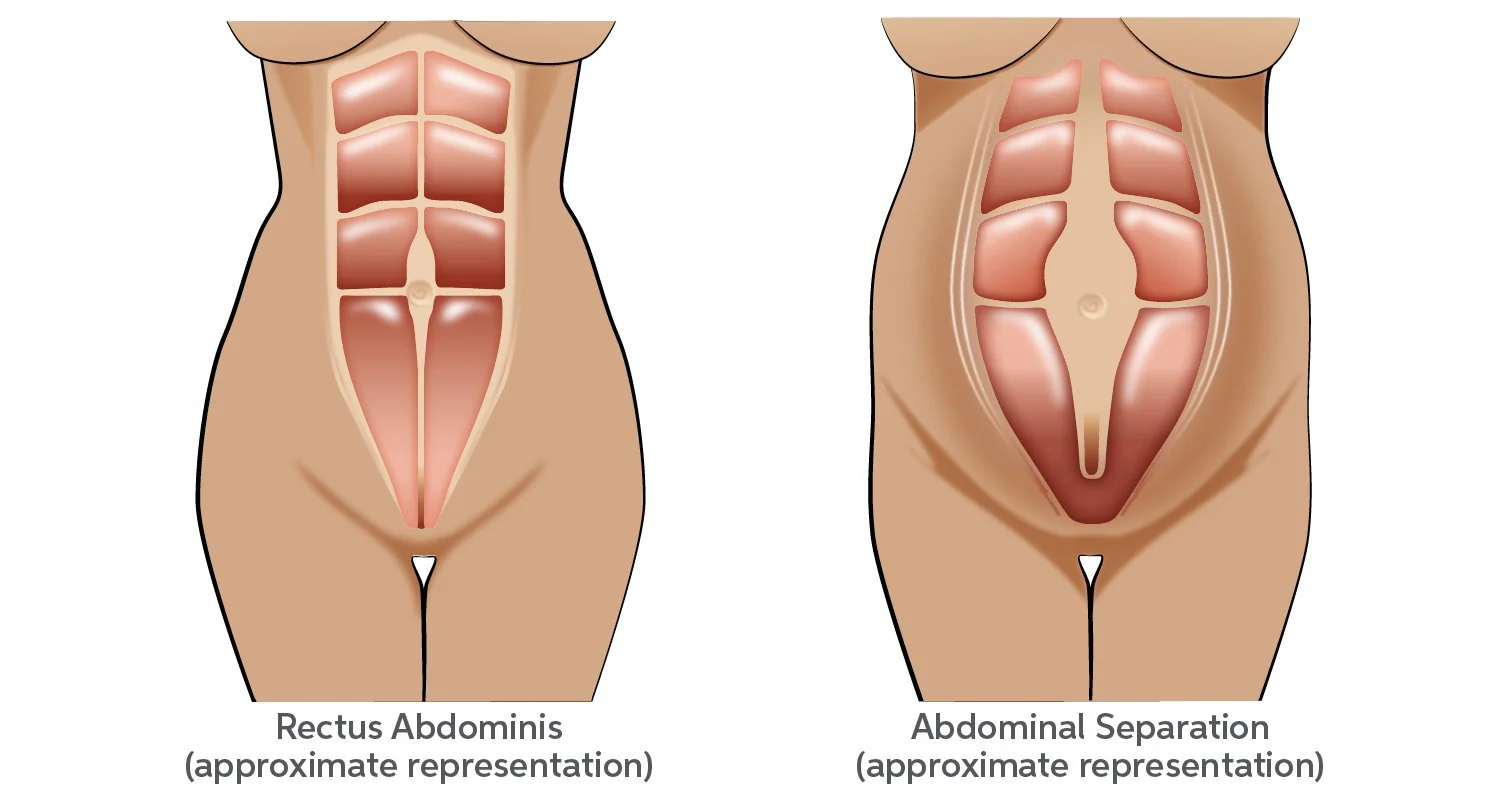
Diastasis recti abdominis (DRA) is a separation of the left and right halves of your rectus abdominis along the midline. The two halves are normally held together by a thin band of connective tissue called the linea alba ("white line"), running from sternum to pubic bone. Diastasis is not a torn muscle. It is a stretched and thinned linea alba that allows the two muscle bellies to drift apart.
Some separation is normal — and necessary — during the third trimester. Under the influence of relaxin (the hormone that also loosens your pelvis), the linea alba softens, and the rectus muscles move sideways to make room for a baby. By 35 weeks, roughly 100% of pregnant women have measurable separation. It is supposed to happen.
What is not supposed to happen is the gap staying open after delivery. The rough timeline:
- By 8 weeks postpartum: about 60% of moms still have measurable diastasis.
- By 6 months: 35–45% still do.
- At 12 months and beyond: roughly 30% have a persistent gap that will not close without targeted intervention.
The why is three-layered:
- Hormonal. Relaxin lingers postpartum (longer if you are breastfeeding). Tissue takes time to regain tensile strength.
- Mechanical. Nine months of stretching does not snap back like a rubber band — connective tissue remodels slowly under the right loading.
- Pressure-system dysfunction. This is the piece every program misses. Your abdomen is a pressurized canister: the diaphragm is the lid, the pelvic floor is the floor, the transverse abdominis (TVA) is the wall, the linea alba is the front seam. If those four structures are not coordinated — chest-breathing instead of diaphragm, a weak or hypertonic pelvic floor, an offline TVA, a rotated pelvis feeding pressure asymmetrically — every cough, every sneeze, every carseat lift pushes pressure outward against the weakest wall. That is what keeps it open.
That is why "do dead bugs and bird dogs" is not enough. You are not fixing a muscle. You are fixing a pressure system.
What the Gap Actually Means
The most clinically useful framework:
- Less than 1 finger-width: normal.
- 1–2 finger-widths: mild diastasis. Conservative care almost always closes this.
- 2–3 finger-widths: moderate. Closes or significantly improves with consistent work over 6–12 weeks.
- More than 3 finger-widths, or any persistent gap larger than 2 finger-widths at 6 months postpartum: significant. Conservative care is still the first line, but escalation to pelvic floor PT and possible surgical consult is appropriate.
Depth matters as much as width. A 2-finger gap with a firm, springy floor is in better shape than a 1-finger gap your fingers can sink three knuckles into. The gap is also rarely uniform — many moms have a near-normal gap above the umbilicus and a wider gap at or below. That is why you measure at three points.
The 60-Second Self-Test
The standard finger-gap test (also called the rec check) costs nothing and gives you data you can track weekly.
Setup: Lie on your back, knees bent, feet flat. Relax your stomach — do not suck in. Place two or three fingers flat on the midline of your belly, fingertips pointing toward your feet.
Test at three points:
- About 2 inches above the umbilicus. Press gently in. Lift your head and shoulders just enough to feel your abs engage — like the start of a crunch, not a full crunch. Feel for the two firm muscle walls of the rectus rising on either side of your fingers. Count how many finger-widths fit in the valley between them. Also feel for depth — firm and springy (good) vs. soft and sinking (more concerning).
- At the umbilicus. Repeat.
- About 2 inches below the umbilicus. Repeat.
Write it down. "Week 0: 2 fingers above, 3 at navel, 2 below. Depth soft at navel, firm above and below." Re-test weekly, same time of day. Slow narrowing and firming is what you are tracking.
A few things that throw the test off: bloating, a full bladder, lifting too aggressively, testing right after a workout. And if you cannot find clear muscle edges at all, if the linea alba sinks indefinitely, or if you see a bulge at rest — get an in-person evaluation rather than self-managing.
Why Most Online Diastasis Advice Fails
Open any social media app, search "diastasis recti exercises," and you will get a wall of women on yoga mats doing dead bugs, bird dogs, heel slides, pelvic tilts. Those exercises are not wrong. But they are usually the wrong layer of the problem.
Those programs treat diastasis as a strength deficit. Your core is weak. Strengthen it. The gap closes. That framing ignores the four-part pressure system the linea alba is the front wall of.
The honest mechanism:
- A dome along the midline when you sit up is intra-abdominal pressure being pushed against the weakest wall. Strengthening muscles around that wall without first managing the pressure just gives the pressure more force to push outward with. Many moms get worse.
- Breath-holding during exertion spikes intra-abdominal pressure. If your breath pattern is broken, no exercise program will close the gap.
- A hypertonic pelvic floor — extremely common postpartum, especially after a long pushing stage or perineal tear — cannot coordinate with the diaphragm and TVA.
- A rotated pelvis (Cat 2 sacroiliac torsion in SOT language) feeds the abdominal canister asymmetrically. One side of the linea alba sees more tension than the other — which is exactly why so many moms see their dome ridge slightly off-center.
Fix the pressure system first. The muscles cooperate after that.
The 6-Week Pura Vida Recovery Plan
This is the framework I give postpartum moms in clinic. Pair it with the structural and pelvic floor PT pieces below.
Week 1: Breath and Reconnect
Almost nothing that looks like "exercise." Most moms skip this. The ones who do not, close their gap faster.
- 360° rib breathing, 5 minutes twice daily. Wrap your hands around your lower ribs, thumbs in back. Inhale through the nose and expand your hands outward in all directions — front, sides, back. Most postpartum moms have lost this and are breathing only into the upper chest.
- Diaphragm + pelvic floor connect. Lie down. Inhale: belly and pelvic floor relax down. Exhale through pursed lips: gentle drawing-in of the lower belly, gentle lift of the pelvic floor. No clenching. 3 sets of 8 breaths, twice daily.
- TVA cue. Same setup. On the exhale, imagine zipping high-waisted jeans from pubic bone to navel — a low, gentle drawing-in. 10 reps, twice daily.
- No crunches, no planks, no sit-ups. Carrying the baby is enough load this week.
Week 2: Glutes and Pelvic Set
Your glutes should be doing the work your low back and abdomen are currently trying to do. Most moms come out of pregnancy with profoundly weak glutes.
- Continue Week 1 breath work, daily.
- Glute bridges. Exhale, draw in TVA, squeeze glutes, lift hips. 2-second hold, lower with control. 2 sets of 10. Watch for doming — if you see a ridge, lower the height.
- Supine heel slides. Exhale, draw in TVA, slide one heel away until the leg is nearly straight. Inhale, slide back. 2 sets of 10 per side. Stop on doming.
- Side-lying clams. Knees bent, feet stacked. Exhale and open the top knee like a clam shell, squeezing the outer glute. 2 sets of 10 per side.
Week 3: Add Lower Abdominal Loading
- Continue all prior work.
- Toe taps (tabletop). Knees over hips at 90°. Exhale, draw in TVA, lower one foot to tap the floor, return. 2 sets of 10 per side. Doming = regress to heel slides.
- Standing hip hinges. Push the butt back like closing a car door with your tail. Back flat. Return using the glutes. 2 sets of 10.
- Wall push-ups. 2 sets of 10.
Week 4: Anti-Rotation
Teaching your core to resist twisting forces matters more than producing them.
- Modified bird dog. Hands and knees. Slowly extend opposite arm and leg, 2-second hold. 2 sets of 8 per side. No sway, no doming.
- Pallof press with a light band anchored at chest height. Stand sideways. Press straight forward, resist the pull, 3-second hold. 2 sets of 8 per side.
- Side-lying leg lifts. 2 sets of 10 per side.
Week 5: Closed-Chain Strength
- Bodyweight squats. Sit back into a chair, exhale on the way up. 2 sets of 12.
- Step-ups. 2 sets of 10 per side. Exhale on the work.
- Bird dog progressions — add a hold, then a small arm row.
- Modified planks (knees down, forearm). 15–30 seconds. Tight TVA, no doming. Stay here until full planks produce no ridge.
Week 6: Reassess
Re-do your self-test. Compare to Week 0. You should see measurable narrowing and firming.
If you are progressing: add full planks if no doming, add light loaded deadlifts with breath control, return to your prior fitness routine with breath leading every movement. If you are not progressing, the pressure system has something locked in it that home exercises will not unlock alone. Time for the structural piece below.
Throughout 6 weeks, avoid: crunches, sit-ups, double-leg lowers, full planks too early, twisting loaded movements, breath-holding lifts, anything that produces a visible dome. If you see a ridge, regress one level.
The Pura Vida SOT Pelvic-Blocking Piece
This is the part of the conversation almost no postpartum mom in San Antonio has been offered. It is the piece that often explains why a diligent six weeks of textbook diastasis exercises have not moved the needle.
Diastasis is not just a midline problem. It is a pelvic geometry problem.
The linea alba runs from the xiphoid process down to the pubic symphysis. Its bottom anchor is the pelvis. If the pelvis is tilted, rotated, or torsioned — which it almost universally is after pregnancy and delivery — the two halves of the pubic symphysis are no longer on the same plane. One side of the linea alba is pulled forward and down, the other backward and up. The connective tissue is being asked to heal under a sideways stretch.
It is like trying to heal a torn seam on a shirt while one shoulder of the shirt is being yanked sideways. The tissue can lay down all the fibers it wants — the load keeps pulling them apart.
In SOT — Sacro-Occipital Technique — this pattern has a specific name: Category 2 (sacroiliac instability), and sometimes Category 1 (cranial-sacral dural tension). Both are extremely common postpartum. The corrections are not high-velocity. They are precise placements of small wedge-shaped pelvic blocks under specific landmarks while you lie face-down, allowing gravity itself to slowly reset pelvic geometry over several minutes.
A SOT Category 2 reset typically takes 12–20 minutes per visit. It is gentle to the point that many moms ask if anything is happening. What is happening: the sacroiliac joints are unloaded asymmetrically, the ligaments settle back toward pre-pregnancy alignment, the pubic symphysis re-levels, the two halves of the pelvis return to the same plane. The linea alba is no longer being asked to heal under a sideways load.
That is when the home exercises start to actually close the gap.
This is where SOT differs from generic chiropractic. Most chiropractic offices in San Antonio practice diversified spinal manipulation — high-velocity, low-amplitude adjustments. For a postpartum pelvis with stretched ligaments and active relaxin still in the system, high-velocity adjustment of an already-loose pelvis is the wrong tool. What that pelvis needs is low-force structural reset that holds. SOT is built for exactly this. Pair it with Webster Technique (which I am certified in and use postpartum as well as prenatally), and the pelvic geometry actually stabilizes.
Read more on the SOT chiropractic page and the prenatal & postpartum chiropractic page.
When to Refer to a Pelvic Floor PT
The fourth wall of the pressure canister is your pelvic floor — and assessing it internally is outside a chiropractor's scope. It is exactly inside the scope of a pelvic floor physical therapist. For a real percentage of postpartum moms, pelvic floor PT is non-negotiable.
Patterns that warrant a referral:
- Urinary leaking with cough, sneeze, jump, run, or laugh
- Fecal incontinence or urgency
- Pelvic organ prolapse symptoms (heaviness, dragging, visible bulge)
- Painful intercourse postpartum
- A C-section scar that is restricted, adhered, or tender
- A perineal tear repair healing tight or painful
- Persistent tailbone, low back, or pubic bone pain
- A diastasis that is not closing with consistent home work
I refer regularly to the pelvic floor PTs in San Antonio — they are some of the most clinically valuable providers in this city, and they can do internal assessment, manual therapy, and biofeedback that I cannot. The best outcomes I see in my practice for stubborn diastasis are moms who do the trifecta:
- The home exercise program above.
- The structural piece — SOT pelvic blocking and Webster-based postpartum care.
- The pelvic floor PT piece — internal assessment and treatment.
Pick one of those and you might close a moderate gap. Pick two and you will close most. Pick all three and even significant diastasis with prolapse, leaking, and persistent pain typically resolves within 3–6 months. If you are a Pura Vida patient and not sure who to call, ask at your visit and we will help you find a pelvic floor PT in your part of town.
Red Flags Requiring Escalation
Most diastasis closes with the trifecta. Some does not. Signs that mean escalating to a surgical consult or OB recheck:
- A visible bulge or protrusion at rest along the midline — possible umbilical or epigastric hernia, needs imaging.
- A persistent gap of more than 2 finger-widths at 6 months postpartum despite consistent care.
- A gap that is widening rather than narrowing.
- Severe, persistent low back or pelvic pain that limits daily activity.
- A doughy, indefinitely-sinking linea alba with no return of tension.
- Pain, redness, warmth, or tenderness at a midline bulge — possible incarcerated hernia, this is urgent.
Most postpartum moms do not need surgery. A small minority with severe diastasis, significant hernia, or functional impairment that has not responded to a 12-month conservative trial may be candidates for abdominoplasty with rectus plication. That decision belongs to you, your OB-GYN, and a board-certified surgeon — not a chiropractor and not an Instagram ad.
Frequently Asked Questions
Can diastasis recti heal on its own without exercises? Some can — small gaps under 1 finger-width in moms with otherwise healthy pressure systems often resolve spontaneously. Most cases over 2 finger-widths benefit substantially from a structured program. "Exercising" is really about restoring the pressure system, not building strength.
How long does it take to close a diastasis? With consistent compliance, most moderate (2–3 finger) diastasis closes meaningfully within 6–12 weeks. Severe gaps or those complicated by pelvic floor dysfunction may take 4–6 months. Pace is highly individual.
Should I be wearing a belly binder? Short-term (first 4–6 weeks postpartum), a gentle compression wrap can help proprioception and comfort. Long-term, dependence on a binder can weaken your TVA and pelvic floor because the binder is doing the work they should be relearning.
Can I do crunches yet? Not in the first 6 weeks of a recovery program. Once your gap has narrowed to 1 finger-width or less and the linea alba feels firm with no doming, modified breath-led crunches may be reintroduced. When in doubt, ask your provider.
Will another pregnancy ruin my recovery? Not if your recovery was real. Moms who heal the pressure system properly between pregnancies typically do better with subsequent pregnancies. Webster-based prenatal care in subsequent pregnancies further protects the recovery.
How do I know if I have a hernia versus diastasis? A hernia is typically a small bulge that protrudes at rest (not just when you sit up), may be tender, and sometimes can be gently pushed back in. Diastasis is a gap, not a protrusion. If unsure, get an in-person evaluation — hernia is a medical, not a chiropractic, condition.
I'm a year postpartum and just learning about this. Is it too late? Absolutely not. I see moms one, two, five, and even fifteen years postpartum whose diastasis has been hiding behind back pain, urinary symptoms, or "I just can't get my belly back." The pressure system can be retrained at any age. Earlier is easier; later is still very much possible.
Ready to Get the Structural Piece Looked At?
If you are eight weeks, eight months, or eight years postpartum and your diastasis has not closed the way you were promised — there is almost always a piece of the system no one has assessed. Most of the time, that piece is the pelvis.
I see postpartum moms (and their babies, often in the same visit) at Pura Vida Chiropractic, 2318 NW Military Hwy, San Antonio TX — NW Military just inside Loop 410, easy parking, treatment rooms set up for moms with babies in arms. Consultations and care can be conducted in English or Spanish — I am a fully bilingual Doctor of Chiropractic (Doctor en Quiropráctica).
- Phone: (210) 685-1994
- Free consultation for new patients: Book here
- Online scheduling: Book now
I am the only Advanced SOT-certified chiropractor in the San Antonio area, Webster-certified, with 23+ years working alongside the pelvic floor PTs, OB-GYNs, midwives, and IBCLCs of this city. You do not have to look pregnant a year postpartum. There is a structural answer.
Dr. Dan Foss, DC, is Advanced SOT-certified — the only Advanced SOT certification in the San Antonio area — and Webster-certified for prenatal and postpartum care. He has been in practice in San Antonio for 23+ years. Read his verified clinical outcome for a 100% pain-relief trigeminal neuralgia case documented on ChiropracticResults.com.
Related reading: Prenatal & postpartum chiropractic (Webster Technique) · SOT chiropractic · New patient consultation · Book now · Recognition & verified outcomes