Frenectomy Aftercare: The 14-Day Stretch & Healing Plan from a San Antonio Pediatric Chiropractor | Pura Vida
A San Antonio pediatric chiropractor's complete guide to frenectomy aftercare: the 14-day stretch and healing plan, reattachment red flags, and the cranial SOT bodywork piece that local providers miss.
On this page
You are sitting in your car in the parking lot of the pediatric dentist's office. Your baby is in the carseat behind you, finally asleep after the laser release. On the seat next to you is a one-page handout with diagrams — little arrows pointing at the underside of a tongue, the inside of an upper lip — and instructions about stretching a wound that is currently in your baby's mouth, every two to four hours, for the next two weeks, including overnight.
You have not slept properly in weeks. The whole reason you went through this was because feeding was a battle and your nipples were cracked and your baby was not gaining the way he should. You just want it to work. And now the dentist has handed you a piece of paper that essentially says: the success of this whole thing now depends on you, doing something to your infant's open wound, around the clock, for fourteen days.
If that is where you are right now, take a breath. You are not the first parent to feel terrified in that parking lot. I see this every week. I am Dr. Dan Foss, DC, of Pura Vida Chiropractic in San Antonio — Advanced SOT-certified (the only Advanced SOT certification in the San Antonio area), Webster-certified, with 23+ years working alongside the pediatric dentists and lactation consultants who form the tongue-tie-release team in this city.
This is the article I wish every San Antonio parent had on the drive home from the frenectomy. It is not a substitute for your provider's specific instructions. It is the bigger picture — what is actually happening, why aftercare is the whole game, and the piece almost nobody talks about: the bodywork that has to happen alongside the wound stretches for this to truly fix the feeding problem.
What a Frenectomy Actually Does
A frenectomy (or frenotomy, depending on how much tissue is released) is the surgical release of a restrictive oral frenum — most commonly the lingual frenum under the tongue (tongue tie / ankyloglossia) or the maxillary labial frenum between the upper lip and the gum (upper lip tie). Some children have both, plus restrictive buccal ties along the cheeks.
There are three primary tools:
- CO2 laser — the current gold standard for pediatric ties, used by the experienced tongue-tie dentists in San Antonio. The laser vaporizes tissue cleanly, cauterizes as it cuts, and leaves a precise diamond-shaped wound. Minimal bleeding. Fast healing.
- Scissors (sharp release) — historically used for simple anterior ties, often by IBCLCs, pediatricians, or ENTs in the newborn nursery. Effective for thin anterior ties; less so for thick or posterior submucosal ties because depth is harder to control.
- Electrocautery / hot wire — produces more thermal damage to surrounding tissue than CO2 laser and is less commonly used in current pediatric practice.
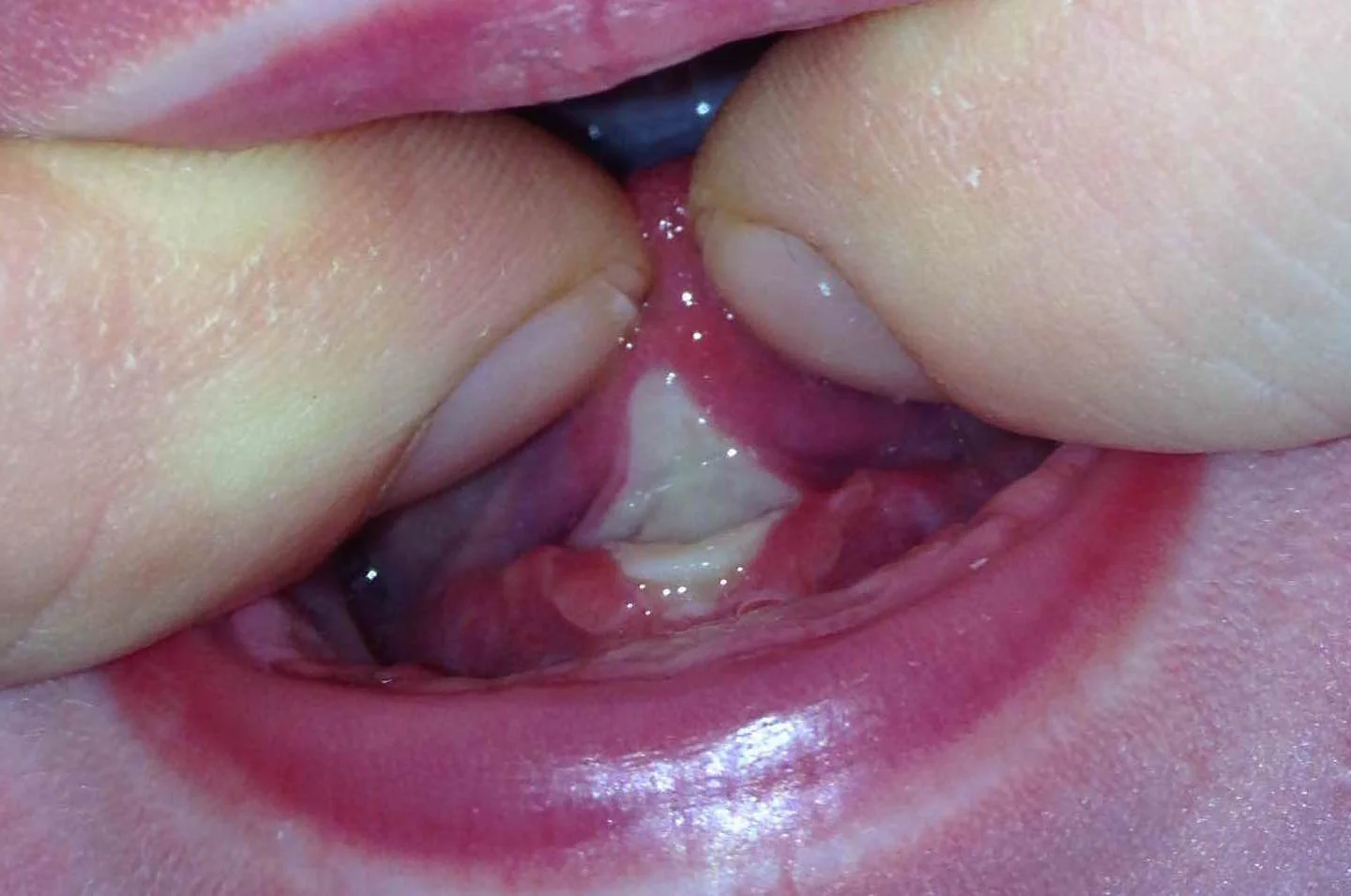
When the release is done well, what you see afterward is a diamond-shaped wound. That diamond is the goal. It means the dentist released not just the surface tissue but the deeper restrictive fibers — the submucosal layer that was actually limiting tongue mobility. A wound that looks like a small slit instead of a diamond usually means the release went only through the visible string and missed the deeper restriction. That is the difference between a release that fixes feeding and one that does not.
Here is the part no one explains clearly enough in the office: the body wants to close that diamond. The mouth has one of the fastest mucosal healing rates in the human body. Within 24 to 48 hours, the wound begins to lay down new tissue. Without active wound management, those edges race toward each other and reattach — sometimes worse than the original restriction, because now there is scar tissue involved. You are not "exercising" the wound. You are preventing reattachment while the body completes deep healing underneath.
Why Aftercare Is the Whole Game
A frenectomy without proper aftercare is often worse than no frenectomy. I see it in clinic constantly — parents come in two months post-release frustrated that feeding still is not working, and when we examine the mouth, the diamond has closed, sometimes with a thick band of scar tissue more restrictive than the original tie.
The biology is simple. The released tissue plane has two surfaces — top and bottom of the diamond — that are now exposed raw mucosa. Mucosa heals fast. If those surfaces touch each other during active healing, they fuse. That fusion is reattachment, the single most common reason a frenectomy "fails."
Reattachment risk is highest days 2 through 10. By day 14, the wound is largely closed and the underlying connective tissue has remodeled into its new resting length.
The common mistakes I see San Antonio parents make:
- Skipping night stretches because the baby is finally sleeping. I understand. I am also telling you this is the number one reason for partial reattachment, because eight hours of motionless tongue-on-floor-of-mouth contact during sleep is exactly the condition the wound needs to refuse.
- Stretching too gently. Light touch does not separate the wound surfaces. Effective stretches require firm, brief, deliberate elevation.
- Stretching too aggressively or for too long. Equally bad. You are not trying to traumatize the wound; you are lifting the edges apart for a few seconds.
- Stopping at day 7 because "it looks healed." A wound that looks closed at day 7 is still reattachment-risk tissue underneath. Run the full window.
- Doing the stretches and nothing else. Stretches release the wound, but they do not release the cranial bones, the upper cervical spine, and the suck-swallow neurology that contributed to the feeding problem in the first place. A baby whose temporal bone and occiput were stuck from birth still has a stuck temporal bone and occiput after the frenectomy.
The 14-day plan that follows is the framework. Your provider's specific stretch technique comes from them. What I am giving you is the structure to hang those instructions on, plus the signs to watch for, plus the bodywork piece your dentist and IBCLC may not have told you about.
The 14-Day Stretch & Healing Plan
Day 0–1: The First 24 Hours
Shock-and-comfort phase. Your baby has just had a procedure performed in his mouth and is sore, possibly sleepy from topical anesthetic, and uncertain.
What to expect: mild fussiness, possible refusal of the first one or two feeds, a small amount of pink-tinged saliva, occasional sneezing or coughing as the baby relearns tongue position.
What to do:
- Feed within the first hour if your baby will accept it. Nursing is soothing and begins to integrate the new range of motion neurologically.
- Skin to skin. Strip the baby to a diaper, get yourself to skin, and stay there. One of the most underutilized post-procedure interventions.
- Comfort measures as approved by your provider. Many San Antonio dentists recommend infant acetaminophen or an arnica protocol for the first 24 hours. Follow their guidance — do not improvise.
- Do not start active wound stretches yet unless your provider specifically said to. Most current protocols delay the first stretch until 4–24 hours post-procedure to allow initial hemostasis.
The first night will be uneven. That is the procedure, not a sign something is wrong.
Day 2–3: Active Stretches Begin
Your provider has instructed you on the specific stretch technique. Typically this involves stretches every 2–4 hours during waking, plus at least one or two overnight stretches, each lasting a few seconds of held elevation, repeated.
I am deliberately not giving you the exact technique here. The right angle and depth depends on the specific release performed on your specific baby. Watch your dentist's video. Practice in their office before you leave. Ask them to watch you do it once if you are unsure.
The mindset matters more than people realize:
- Brief is better than long
- Firm-but-controlled is better than tentative
- Consistent timing matters more than perfection
- A crying baby is not a sign you are doing something wrong — it is a sign you are touching a sore mouth
What you should see at day 2–3: the diamond is still visible. The center may look yellow-white. That is fibrin — the normal scab-equivalent in mucosal tissue. It is not infection. I will say it twice because it terrifies almost every parent I see. The yellow-white center is exactly what should be there. Mucosa does not form red scabs the way skin does.
Day 4–7: The Middle Window
The highest-risk window for reattachment, and the window where parents are most tempted to back off because the baby is fussing, sleep is disrupted, and the wound looks "weird." Stay the course.
Signs of normal healing: diamond still visible with white/yellow fibrin in the center; baby tolerating feeds better than at day 2; possibly improved latch and less clicking; mild fussiness around stretch times, comfortable in between.
Signs that need a call to your provider:
- The diamond is shrinking or closing rather than staying open
- A thick rubbery white film that does not lift with the stretch
- Bleeding beyond a small pink tinge
- Refusal to feed for more than 6 hours
- Fever, lethargy, or signs of systemic infection
- A foul odor distinct from normal milk-breath
Day 8–14: Tapering and Closing
You are most of the way through. Your provider will typically have you continue stretches at the established frequency through day 10–14, then begin tapering — every 4–6 hours, then a few times daily, then natural movement.
What you should see: the diamond shape softens; the fibrin layer thins and is replaced by normal pink mucosa; the tongue's resting position often sits higher in the mouth, closer to the palate (the goal); feeding gains become more apparent, though full feeding mechanics improvement often continues for weeks beyond day 14, especially with bodywork.
By day 14, the active wound management phase is complete. The work then shifts from "preventing reattachment" to "integrating the new range of motion into feeding, swallowing, and oral motor development." That integration is where the cranial and SOT bodywork piece becomes critical.
Red Flags Requiring Immediate Provider Contact
These should never wait until Monday:
- Significant bleeding — more than a pink tinge in saliva
- A thick white reattachment film — rubbery, dense, does not lift with the stretch
- Refusal to feed for more than 6 hours in a young infant
- Fever — any temperature above 100.4°F (38°C) rectally in an infant under 3 months is a medical emergency regardless of cause
- Lethargy — unusual sleepiness, hard to rouse, not making eye contact, floppy tone
- Signs of dehydration — fewer than 6 wet diapers per day, sunken fontanelle, no tears when crying
- Foul mouth odor distinct from normal milk-breath
- Increasing swelling rather than decreasing at days 3–4
When in doubt, call. The pediatric dentists who do CO2 releases in San Antonio expect aftercare questions in the first two weeks. That is part of the procedure they performed.
The Pura Vida Bodywork Add-On: The Piece Almost Nobody Talks About
This is the part of the conversation most San Antonio parents have not been offered, and it is the part that often makes the difference between a frenectomy that "kind of helps" and one that actually resolves the feeding problem.
The truth almost nobody says out loud: the tongue tie was rarely the only thing wrong. In-utero positioning — particularly if your baby was breech, transverse, posterior, head-stuck-in-one-corner, or had a tight nuchal cord — creates mechanical compression of the developing skull. The birth process itself, especially long pushing stages, vacuum or forceps, fast precipitous deliveries, or C-section after labor, adds another layer of cranial compression. By the time your baby was born, several of the bones of his skull were likely sitting in restricted positions.
Those restricted cranial bones contribute directly to the feeding problem the frenectomy was supposed to fix. The frenectomy released the tongue. It did not release the skull.
The bodywork specifically addresses:
Temporal bone restrictions. The temporal bones house the middle ear, and the muscles of suck-swallow coordination — particularly the tensor veli palatini and levator veli palatini — operate through structures associated with the temporal bone. A baby with a stuck temporal bone often clicks during nursing, breaks suction repeatedly, and may have related ear-canal issues. Releasing temporal bone restriction directly improves suck-swallow rhythm.
Sphenoid bone restrictions. The sphenoid is the central bone of the skull and influences brainstem oral motor planning through dural connections. A baby whose sphenoid is in torsion or compression has a harder time coordinating the complex motor sequence nursing requires. Gentle sphenoid release — done with the pressure of checking a ripe tomato — restores normal motion.
Occipital bone restrictions. The occiput is where the cervical spine meets the head, and where the hypoglossal nerve (cranial nerve XII) — the nerve that controls the tongue — exits through the hypoglossal canal. If the occiput is rotated or compressed, the hypoglossal nerve has less room and tongue motor control is partially inhibited. Occipital release is one of the most consistently impactful adjustments in post-frenectomy infant care.
TMJ asymmetry. Even infants have a TMJ, and asymmetry in jaw mechanics — usually from intrauterine positioning — makes one side of the latch more efficient than the other. This is why so many tongue-tied babies prefer one breast.
Upper cervical alignment. The C1 (atlas) and C2 (axis) directly under the skull are commonly rotated after birth. That rotation feeds back into cranial mechanics, vagal tone, and head-positioning during nursing.
What a Pura Vida Pediatric Visit Looks Like
- Length: about 30 minutes
- Setting: quiet, low-lit, often with mom on the table next to baby
- Pressure: the SOT cranial work I do on infants uses pressure roughly equivalent to checking whether a tomato is ripe. No cracking, no twisting, no popping of any part of an infant.
- Sequence: I assess the cranial bones — sphenoid, temporal, occiput, frontal, parietal — then upper cervical, then sacrum and pelvis (because the sacro-occipital connection means a stuck sacrum feeds a stuck occiput), then re-evaluate cranial mechanics.
- What baby does: most fall asleep partway through, or feed at the breast while I work.
- Frequency: typically 2–4 visits in the first month post-release, then re-evaluation.
This is pediatric chiropractic care done with the precision an infant requires. It is fully compatible with — and complementary to — your IBCLC's bodywork and oral motor exercises.
Coordinated Care, and Mom
Babies who do best after a frenectomy have a coordinated team: the pediatric dentist who performed the CO2 release, the IBCLC troubleshooting latch, the pediatrician monitoring weight gain, and the cranial SOT chiropractor addressing the skull, neck, and pelvis.
And mom. The parent doing the night stretches is often still recovering from a birth that did a number on her sacrum, pelvis, and cervical spine. Webster Technique is most associated with prenatal care, but the same structural framework applies to postpartum recovery. A mom whose body is in a better mechanical place feeds better, sleeps better, and has more capacity for the demanding aftercare protocol.
Working With the Local San Antonio Providers
San Antonio has a strong tongue-tie ecosystem, and Pura Vida fits into it as the bodywork piece of a team-based approach.
The CO2-laser pediatric dentists in San Antonio are who I refer to and work alongside. The ones who do high-volume tongue-tie work in this city are excellent, and the diamond wounds I see in clinic from their releases are textbook. Your dentist's aftercare instructions are correct for the release they performed. My job is the cranial, cervical, and sacral mechanics upstream of the tongue.
The IBCLCs in San Antonio who specialize in tongue-tie aftercare are the lactation consultants I most frequently coordinate with. They handle latch mechanics, milk transfer, weight gain, and feeding position. A good IBCLC will refer to bodywork; a good bodyworker refers back to the IBCLC for feeding-specific questions.
The myofunctional therapists in San Antonio. Faith De La Garza at Me-O-Myo is one of the providers I have referred patients to — and accepted referrals back from — for years. Myofunctional therapy is the missing piece for many tongue-tie families: the frenectomy releases the restriction, the bodywork releases the cranial and cervical patterns the tongue was compensating around, and the myofunctional therapist teaches the tongue what to do with its new freedom. For older infants, toddlers, and especially older children whose tongue tie was missed at birth, this neuromuscular re-education is what makes the release stick. Faith works with infants through adults, and her oral-motor approach pairs naturally with cranial SOT.
The pediatricians who refer to this team are the ones who recognize that not every feeding problem is "just colic" or "give it time." Many San Antonio pediatricians now keep a chiropractic referral on their list — ask yours.
Pura Vida is not trying to replace anyone. We are filling the gap that exists in the standard aftercare protocol.
Frequently Asked Questions
How long until breastfeeding feels different? Some mothers feel a difference at the first post-procedure feed because the tongue can now extend properly. More commonly, improvement is gradual over 2–4 weeks as the wound heals, the new range of motion integrates neurologically, and cranial restrictions (with bodywork) resolve. If you see no improvement by week 3 despite consistent stretches, that is the moment to evaluate whether a cranial or oral-motor piece is being missed.
Can I do the stretches without traumatizing my baby? Yes. Babies cry not because they are being traumatized but because their mouth is sore and they are being touched in a way they do not like. The crying stops within minutes of the stretch ending. What they do remember — in the deep nervous-system way infants encode experience — is the regulated parent doing the stretches with calm confidence, followed by skin-to-skin and feeding. Stay regulated. They take their cues from you.
What if my baby refuses the stretches? Infants do not have the developmental capacity to refuse. They are uncomfortable, and you are doing the thing anyway because it is medically necessary. The way through is technique, not negotiation: brief, firm, deliberate stretches followed by immediate comfort. If you dread the stretches, talk to your provider about your technique — small adjustments can make the process less aversive for both of you.
When is it OK to skip a stretch session? In general, do not skip. One missed stretch does not undo the work, but missing several — particularly in the day 2–10 window — meaningfully increases reattachment risk. Night stretches are the ones most often skipped and the ones most often associated with partial reattachment. Set the alarm.
Why does the wound look white — is that infection? Almost certainly not. The white-to-yellow patch in the center of the diamond is fibrin, the normal mucosal equivalent of a scab. Mucosa does not form red scabs the way skin does. Infection signs are different: spreading redness around the wound, foul smell, fever, lethargy, refusal to feed. Fibrin alone is not infection.
Do I really need to wake my baby for night stretches? Yes, in most protocols, for the first 10–14 days. I know how hard that is. The wound surfaces are most likely to reattach during long periods of motionless contact — which is what happens during sleep. If your provider has cleared you to space night stretches further apart, follow their guidance. But "skip night stretches because baby is sleeping" is generally not the right call in the first two weeks.
When can chiropractic care start after a frenectomy? Immediately. The ideal window for the first bodywork visit is 2–7 days post-release, when the wound is healing and the cranial mechanics are still adjusting to the new tongue position. Pre-procedure bodywork — in the week or two before the release — is also valuable when timing allows.
Is this covered by insurance? Chiropractic visits at Pura Vida are billed transparently. Many San Antonio insurance plans cover pediatric chiropractic, though benefits vary. We verify your benefits before your first paid visit, and the free consultation is exactly that — free.
What if we already missed the 14-day window? Bodywork is still valuable at week three, week six, or month three. The cranial restrictions, occipital rotation, and upper cervical patterns I work on do not have an expiration date. If feeding still is not where it should be at three months post-release, the question is not "did we miss the window" — it is "what piece has not been addressed yet?" Often that piece is cranial.
When should I worry about reattachment? If your diamond is closing faster than expected, the wound looks like a slit instead of a diamond when you lift the tongue, or feeding gains you initially saw are regressing in week 2–4 — those are reattachment concerns and your dentist needs to see the baby. Caught early, reattachment is often manageable without a full re-release.
Ready to Add the Bodywork Piece to Your Baby's Aftercare?
If you are sitting in that parking lot — or three days, or three weeks, or three months out from your child's frenectomy — and feeding is still not where you hoped, the missing piece is often cranial.
I see infants and toddlers post-frenectomy at Pura Vida Chiropractic, 2318 NW Military Hwy, Suite 103, San Antonio TX — just inside Loop 410, easy parking, quiet treatment rooms designed for babies and the parents holding them.
- Phone: (210) 685-1994
- Free consultation for new patients: Book here
- Online scheduling: Book now
Consultations and care are conducted in English or Spanish — I am a fully bilingual Doctor of Chiropractic (Doctor en Quiropráctica). I am the only Advanced SOT-certified chiropractor in the San Antonio area, Webster-certified for prenatal and postpartum care, with 23+ years working alongside the pediatric dentists, IBCLCs, and pediatricians in this city.
Dr. Dan Foss, DC, is Advanced SOT-certified — the only Advanced SOT certification in the San Antonio area — and Webster-certified for prenatal and postpartum care. He has been in practice in San Antonio for 23+ years. Read his verified clinical outcome for a 100% pain-relief trigeminal neuralgia case documented on ChiropracticResults.com.
Related reading: Pediatric chiropractic care · SOT chiropractic · Cranial chiropractic · Webster Technique & prenatal chiropractic · Book a free consultation · Recognition & verified outcomes