How to Get Rid of Cradle Cap Naturally: A Step-by-Step Photo Guide from a San Antonio Family Chiropractor | Pura Vida
A San Antonio pediatric chiropractor's complete natural treatment guide for cradle cap: 4 oils compared (coconut, jojoba, tallow, olive), a 6-week week-by-week protocol, when to escalate to a dermatologist, and the cranial SOT bodywork piece nobody is talking about.
On this page
It is 2:17 in the morning. Your baby is asleep on your chest, and you are scrolling on your phone in the dark. Earlier that evening, while running your fingers through that impossibly soft hair, you felt them — patches. Crusty, waxy, yellowish flakes glued to the scalp behind the ear and along the soft spot. Your three-week-old looks otherwise perfect, but those patches were not there last week, and now you are deep in the kind of late-night research spiral every new parent knows.
One site says "scrub it off." Another says "never scrape it." One says coconut oil, another olive oil, another the $34 bottle. One forum post tells you to switch formulas. Another to cut dairy. Another that it's a sign of food allergy. Another that it's harmless.
Take a breath. You are dealing with cradle cap — almost always benign, almost always treatable at home, almost always gone by your baby's first birthday. I am Dr. Dan Foss, DC, of Pura Vida Chiropractic in San Antonio. I am Advanced SOT-certified — the only Advanced SOT certification in the San Antonio area — Webster-certified, with 23+ years in pediatric and family practice. I see cradle cap every week. Here is the article I wish every new parent in this city had on the drive home from the hospital.
What Cradle Cap Actually Is
The medical name is infantile seborrheic dermatitis. The "seborrheic" tells you what is happening — it refers to sebum, the natural oil produced by the sebaceous glands. Cradle cap is a temporary disturbance in how those glands behave during the first few months of life. Two mechanisms drive it.
Maternal hormones. During the third trimester, your hormones cross the placenta. Those hormones — particularly androgens — stimulate your baby's sebaceous glands, and the activity does not switch off at birth. For the first 2–3 months, your baby's skin is producing sebum at a level closer to a teenager's than a newborn's. That excess oil collects keratin from skin cells and forms the yellowish, waxy plaque.
Malassezia yeast. This yeast (formerly Pityrosporum) normally lives on human skin without causing problems. In the high-sebum environment of an infant scalp, it proliferates and triggers a low-grade inflammatory response — the same yeast involved in adult seborrheic dermatitis and dandruff.
Age of onset: typically 2 weeks to 3 months, peaking around 4–8 weeks. Most cases resolve by 6–12 months as maternal hormones clear and the sebaceous glands quiet down.
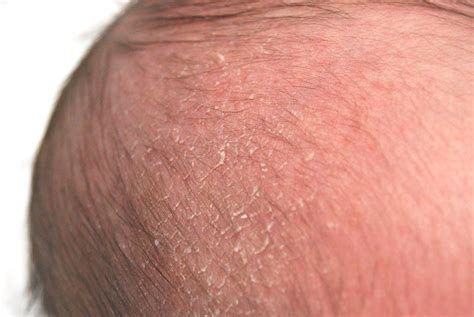
What it looks like: yellowish, white, or tan scaly patches, often greasy or waxy, ranging from a few thin flakes to thick crusts. Sometimes mildly red underneath.
Where it shows up: scalp (almost always, especially around the soft spot), eyebrows (fine flaking, often mistaken for "dry skin"), behind the ears (classic, often missed), occasionally nasal folds, chin, or diaper area.
What cradle cap is NOT: not eczema (eczema is itchy, dry, allergic-immune driven — cradle cap is greasy and not itchy); not a hygiene issue (the most diligently bathed baby in San Antonio can have a thick crust); not contagious (siblings, parents, pets, grandmothers — no one can catch it).
Why the Natural Approach Works
The instinct of every new parent who sees those patches is to attack them. Scrub harder. Pick the edges. Buy the strongest medicated shampoo at HEB. That instinct is wrong.
Cradle cap is a scale problem layered on a sebum-and-yeast problem. The yellow plaque is keratin — old skin cells — held together by sebum. What you need is to soften the scale so it lifts away on its own without trauma to the developing skin underneath.
A gentle plant or animal oil does exactly that: softens the keratin by breaking the sebum bonds; lets scale release without scraping; supports the infant skin barrier because oils are biologically similar to the lipids skin produces; avoids the problems of medicated approaches (topical steroids thin infant skin; antifungal shampoos can be too harsh for what is largely self-limiting).
In clinic I see parents who scrubbed, picked, or used adult dandruff shampoo on infant scalps. The result is almost always worse: irritation, redness, broken skin, sometimes secondary infection. The natural protocol is slower but works with the biology, not against it.
The 4-Oil Comparison: Which One Actually Works Best
Every cradle cap article online tells you to "use coconut oil." That is not wrong, but it is not the whole picture. Here is the honest head-to-head of the four oils I actually recommend in clinic, and when to choose which.
1. Jojoba Oil — My First Choice
Technically a liquid wax from the seeds of the Simmondsia chinensis plant. It tops my list for one molecular reason: jojoba is the closest match to human sebum of any commonly available oil. Your baby's skin recognizes it as something it already makes.
Why it works: penetrates and softens scale because it integrates into the sebum layer; non-comedogenic; very low allergenic potential; mild and nearly odorless; doesn't go rancid.
Cons: more expensive ($12–$20 for a quality bottle vs. $4–$8 for coconut); has to be sourced carefully — look for "100% pure cold-pressed jojoba oil," organic if possible. Avoid "jojoba blend" or anything with added fragrance.
Verdict: if cost is not the limit, start here. The cleanest, gentlest, most physiologic option for an infant scalp.
2. Coconut Oil — Strong Second Choice
Pressed oil from coconut meat — solid at room temperature, melts at body temp. The most-studied oil for cradle cap.
Why it works: antimicrobial against Malassezia — coconut oil contains medium-chain fatty acids (lauric and capric acid) with documented activity against the yeast that contributes to cradle cap. This gives it a slight clinical edge over purely emollient oils. Inexpensive, widely available, excellent emollient.
Cons: mildly comedogenic for some infants — can clog pores and occasionally worsen inflammation in babies already prone to acne or folliculitis.
What to buy: virgin (unrefined) coconut oil, organic if possible.
Verdict: if jojoba is out of reach, this is a strong, well-supported choice. For infants with existing acne or folliculitis, lean to jojoba.
3. Tallow — For Resistant Cases
Rendered fat from grass-fed beef. The word makes people flinch, but stay with me — tallow is one of the closest matches to human skin lipids of any traditional emollient.
Why it works for resistant cases: skin-identical lipids — palmitic, stearic, and oleic acids in roughly the same ratio as human sebum. Excellent for sensitive infants where plant oils are not landing. Rich in fat-soluble vitamins (A, D, E, K). Penetrates deeply.
Cons: has an animal-fat note some parents dislike. Solid at room temperature, harder to spread than jojoba. Sourcing matters — get properly rendered tallow from a small producer (Vintage Tradition, Toups & Co.), not grocery-store suet.
Verdict: I reach for tallow when 2 weeks of jojoba or coconut have not made progress, when the infant has very sensitive skin, or when the cap is dense and resistant. Not first-line — but a quiet winner for hard cases.
4. Olive Oil — Last Choice, With a Warning
The traditional grandmother remedy — the bottle is already in your kitchen. But a 2018 study (Danby et al., Pediatric Dermatology) found that olive oil applied to infant skin disrupted developing skin barrier function compared to a no-oil control — likely because high oleic acid content disturbs the lipid lamellae of immature skin. The finding has shifted how pediatric dermatologists think about olive oil for infants under 3 months.
Verdict: if it is the only thing in the house tonight, not catastrophic. But if you can get jojoba or coconut, do that.
Bottom Line
- First: jojoba — gentlest, most physiologic
- Strong second: coconut — antimicrobial bonus, widely available
- Resistant cases: tallow — skin-identical fats for sensitive infants
- Last resort: olive oil — disrupts infant skin barrier per current evidence
The 6-Week Cradle Cap Protocol
This is the framework I walk parents through in clinic. Your baby may move faster or slower. The structure is the same.
Week 1–2: Softening Phase
The goal is to soften the scale, not remove it. Resist the urge to lift or comb anything yet. You are setting up the chemistry.
Daily protocol:
- Apply oil 30 minutes before bath. Use your fingertip — about a pea of oil per quarter-sized area. Massage gently with the pad of your finger in small circles. The pressure is the pressure you would use to check whether a tomato is ripe. No scrubbing.
- Let the oil sit for 30 minutes. Keep a hat or soft towel handy — oil transfers.
- Gentle soft-bristled infant brush for 60 seconds in circular motions. The bristles should bend easily. You are encouraging loose flakes to lift, not scrubbing.
- Mild shampoo bath to rinse — fragrance-free baby shampoo (Vanicream Baby, CeraVe Baby). Massage gently, rinse thoroughly.
- Pat dry. Do not rub.
Frequency: once daily.
What you should see by end of week 2: scale looks softer, less crusty, some flakes lifting on their own during brushing. Color less intense. Patches stable, not spreading.
Escalate this phase if: patches spreading rapidly; visible redness, weeping, oozing under scale; fever, fussiness, or feeding refusal; skin under scale looks raw or broken.
Week 3–4: Lifting Phase
The scale is softened. Now you can gently lift the loosened flakes.
Daily protocol:
- Apply oil 30 minutes before bath (same as before).
- Add a fine-tooth comb step. Use a clean baby comb to gently lift softened flakes, combing in the direction hair grows. If a flake does not lift in one or two passes, leave it — it is not ready.
- Continue the soft-brush step.
- Mild shampoo bath, rinse, pat dry.
Frequency: daily, possibly twice daily for thick patches — a morning oil-and-brush plus the evening pre-bath protocol.
What you should see by end of week 4: most original scale gone or thinning significantly. New patches may still appear because the sebaceous glands are still active. Trajectory should be visibly improving.
Escalate this phase if: no improvement after 4 weeks of consistent protocol; new inflammation (red, weeping); severe diaper area or under-arm involvement; signs of secondary infection (yellow pus, foul odor, increasing warmth).
Week 5–6: Maintenance Phase
The original cradle cap is largely resolved. Now you manage the still-active sebaceous environment.
Protocol: oil 2–3 times per week (not daily); soft-brush massage at bath; regular gentle shampoo. Watch the original worst spots — behind ears, eyebrows, soft spot — these recur first if anything is going to.
What you should see by end of week 6: most infants are fully cleared or at mild, manageable maintenance. Some take longer — up to 6–12 months as maternal hormones clear. That is still normal.
Escalate this phase if: no progress at all by week 6 on consistent protocol; baby is past 6 months old and condition is not improving; new body areas becoming involved; findings now look more like eczema (itchy, dry, on cheeks and limbs).
The Cranial SOT Angle Nobody Is Talking About
This is the piece almost no other article on cradle cap will tell you, and the piece that — in clinic, over 23+ years — I have watched change outcomes for cases not responding to oil alone.
Cradle cap is conventionally described as a problem of the skin. Sebum, yeast, hormones. That description is correct as far as it goes, but it leaves out a layer: the skin does not regulate itself in isolation. It is regulated by the autonomic nervous system, and that nervous system passes through the bones of the skull.
The sebaceous glands are autonomically innervated. Sebum production is controlled by sympathetic fibers, and those fibers reach the scalp via branches passing through cranial foramina — small openings in the bones of the skull. The vagus nerve, the trigeminal branches, and the cervical sympathetic chain all participate in regulating head and neck skin.
Many infants with cradle cap have cranial bone restrictions. Conventional literature is silent on this, but I have observed it hundreds of times. Infants from difficult births — long labor, posterior position, vacuum or forceps assist, precipitous deliveries, C-section after labor — frequently arrive with restrictions in the occipital, sphenoid, or temporal bones. The cranial bones are designed to mold during birth and return to neutral motion afterward. When they do not — when the occiput is rotated, the sphenoid in torsion, the temporal bone stuck — the cranial-sacral rhythm that supports normal autonomic function is disrupted.
When cranial mechanics are off, local autonomic regulation can be affected. In my clinical experience, infants with stuck cranial bones often present with a constellation — feeding difficulties, sleep dysregulation, persistent head preference, reflux — and sometimes a more stubborn cradle cap than the oil protocol alone would resolve.
This is clinical observation, not established research. The specific studies do not yet exist. I am telling you what I see. But the pattern is consistent enough that when a 4-month-old's cradle cap has not budged on 6 weeks of dedicated oil protocol, the next thing I evaluate is the skull. Some infants resolve completely after 2–4 cranial SOT sessions while continuing the oil protocol. Some begin responding to oil only after the cranial work starts. Many do not need cranial work at all — they resolve on the oil protocol alone, and that is the best outcome.
What a Pura Vida Pediatric Cranial Visit Looks Like
- Length: about 30 minutes
- Pressure: the pressure of checking whether a tomato is ripe. No cracking, no twisting, no popping. Nothing aggressive happens with infants.
- What I assess: sphenoid, temporal, occipital, frontal, and parietal bones; upper cervical alignment (C1-C2); sacrum and pelvis (because the sacro-occipital connection means a stuck sacrum feeds a stuck occiput)
- Frequency: typically 2–4 visits over 3–6 weeks alongside the oil protocol
- What baby does: most fall asleep partway through, or nurse during the work
This is pediatric chiropractic care at the precision an infant requires, paired with cranial SOT for the cranial mechanics involved. I am not telling you cradle cap is caused by cranial bones. I am telling you that for the subset of cases not responding to standard care, the cranial mechanics deserve a look conventional pediatric medicine does not give them.
When to See a Dermatologist Instead
The natural protocol works for the great majority of cases. There are presentations where the right call is a pediatric dermatologist, not a chiropractor.
See a dermatologist (or your pediatrician for referral) if you see:
- Spreading beyond scalp, eyebrows, and behind the ears — particularly to cheeks, trunk, or limbs
- Visible inflammation underneath the scale — red, weeping, oozing, raw
- Persistent past 12 months of age — the differential then opens to chronic seborrheic dermatitis, atopic dermatitis, psoriasis, others
- Fever, fussiness, or feeding refusal — not features of normal cradle cap
- Secondary bacterial infection — yellow pus, foul odor, spreading warmth, swelling
- Severe diaper area involvement
- Broken or cracked skin under the scale
When in doubt, dermatologist first, chiropractor second. I am not the right call for actively inflamed or infected skin. The cranial SOT angle is for stubborn-but-otherwise-benign cradle cap that the oil protocol alone is not resolving — not for inflammatory dermatologic disease. A good pediatric dermatologist can rule out the look-alikes in a single visit.
Frequently Asked Questions
Is cradle cap contagious? No. It is your baby's own skin responding to maternal hormones and the natural skin yeast everyone has. You cannot catch it, siblings cannot catch it, and your baby did not catch it from anyone.
Will it go away on its own? Almost certainly. Most cases resolve within 6–12 months as maternal hormones clear and sebaceous glands settle. We treat for comfort, appearance, and preventing rare progression to inflammation or secondary infection.
Can I just scrape it off? No. Scraping before the scale is softened pulls up healthy underlying skin cells, creating raw spots and entry points for infection. The natural protocol works because it lets the scale lift on its own once chemically loosened. Patience over force.
Why did my baby get cradle cap and my friend's didn't? Individual variation in sebaceous response to maternal hormones, in skin Malassezia populations, and a genetic component. It is not a reflection of your prenatal care, hygiene, or nutrition. Some babies have it densely, some barely, some never.
Will it cause permanent hair loss? No. Sometimes a flake lifts away with a few hairs attached — that is normal shedding, not pathologic loss. Hair grows in normally as the skin clears.
Can I use just baby shampoo without the oil step? For very thin or minimal cradle cap, sometimes. For anything more, shampoo alone does not soften the scale enough to lift it cleanly. The pre-soak is what gives the protocol its effectiveness.
What about Vanicream, CeraVe Baby, or commercial cradle cap products? The well-formulated baby products (Vanicream Baby, CeraVe Baby, Babo Botanicals) work fine as the shampoo step. The marketed "cradle cap treatments" containing ketoconazole, salicylic acid, or selenium sulfide are formulated for adult dandruff — not first-line for infants, and should be used only on pediatrician or dermatologist recommendation, not on Amazon copy alone.
When does pediatric chiropractic make sense for cradle cap? Three scenarios. First, cradle cap plus other findings — head preference, feeding difficulties, sleep issues, reflux, asymmetric movement. Second, when cradle cap is not responding to a fully-executed oil protocol after 4–6 weeks. Third, when birth history included factors that commonly create cranial restriction — vacuum or forceps, very long pushing stage, C-section after labor, breech presentation. Cradle cap alone in a textbook-healthy infant responding to oil — no need.
Is cradle cap related to eczema later in life? Maybe, weakly. Some research suggests a modest association with later atopic dermatitis, but most infants with cradle cap do not go on to develop chronic eczema. The two conditions are mechanistically distinct.
Should I cut dairy or change my diet if I'm breastfeeding? For uncomplicated cradle cap, no. If your baby has cradle cap plus findings suggestive of food sensitivity (significant reflux, blood in stool, severe eczema, chronic gas), discuss a structured elimination trial with your pediatrician. Empirically cutting dairy at 2am for cradle cap alone is not the answer.
Ready for the Bodywork Piece?
If your baby's cradle cap is not budging on the oil protocol, or if you are seeing the constellation of head preference, feeding struggles, sleep issues, and skin findings that often travel together — that is when the cranial SOT piece is worth considering.
I see infants at Pura Vida Chiropractic, 2318 NW Military Hwy, San Antonio TX — NW Military just inside Loop 410, easy parking, quiet treatment rooms designed for babies and the parents holding them.
- Phone: (210) 685-1994
- Free consultation for new patients: Book here
- Online scheduling: Book now
Consultations and care are conducted in English or Spanish — I am a fully bilingual Doctor of Chiropractic. The 2am scroll-spiral does not have to be how you make decisions about your baby. Bring me the questions.
Dr. Dan Foss, DC, is Advanced SOT-certified — the only Advanced SOT certification in the San Antonio area — and Webster-certified for prenatal and postpartum care. He has been in practice in San Antonio for 23+ years. Read his verified clinical outcome for a 100% pain-relief trigeminal neuralgia case documented on ChiropracticResults.com.
Related reading: Pediatric chiropractic care · Cranial chiropractic · SOT chiropractic · Frenectomy aftercare: the 14-day plan · Tongue tie and infant feeding · Ear infections in infants · Book a free consultation