Plantar Fasciitis: Why Your Heel Pain Won't Go Away — A San Antonio Chiropractor's Complete Guide | Pura Vida
A San Antonio chiropractor's evidence-based plantar fasciitis guide: why it's almost never JUST about the foot, the pelvic-rotation pattern nobody checks, the SOT + Class IV laser + acoustic wave therapy protocol that resolves most cases in 6-12 weeks, and the at-home protocol that actually works.
On this page
You swing your legs over the side of the bed, plant your feet on the floor, push up to stand — and a hot ice-pick drives up through your heel. You gasp, half-hop, half-limp to the bathroom on the outside edge of that foot. By the time you have finished your coffee the pain has eased to a bruise-like ache. You almost forget about it. Then you stand up after lunch, or step out of the car at the H-E-B parking lot, and the ice pick is back.
That has been your life for eight months now. You have already done everything the internet told you to do. Drugstore inserts. The custom orthotics your podiatrist sold you for $450. KT tape. Ibuprofen, sometimes three times a day. A frozen water bottle under the desk. Two cortisone injections that worked for six weeks each. A night splint that you wore exactly four nights before kicking it off in your sleep. Your doctor told you, kindly, "it just takes time." It has been eight months. It is not just taking time. Something is wrong with the diagnosis.
I am Dr. Dan Foss, DC, of Pura Vida Chiropractic in San Antonio — 23+ years in practice, the only Advanced SOT-certified chiropractor in the San Antonio area, and Webster Technique certified. This is what plantar fasciitis actually is, why so many cases stall out for months, the single piece of the picture almost no provider checks, and the structural protocol that resolves most chronic cases without surgery.
What Plantar Fasciitis Actually Is
The plantar fascia is a thick, fibrous band of connective tissue that runs along the bottom of your foot from the calcaneus (heel bone) forward to the base of the metatarsals at the ball of the foot. Picture a triangular bowstring — heel as the anchor, toes as the far end, the long arch of the foot held up between them. Every time you step, the plantar fascia stretches; every time you push off, it loads like a spring and helps propel you forward.
That fascia is built to take load. What it is not built to take is repetitive micro-tension at a single point, every step, forever. The point that fails first is almost always the same one: the medial calcaneal tubercle, the inner edge of the heel where the fascia anchors to bone. Repetitive tensile load at that insertion produces microtears, the body lays down disorganized repair tissue, and the area becomes painful, thickened, and slow to heal.
There is a vocabulary point worth knowing. The textbook name is plantar fasciitis — Latin for "inflammation of the plantar fascia." But beginning around the early 2000s, biopsy studies of chronic plantar fascia tissue showed something unexpected: by the time most patients present in clinic, the tissue is not inflamed. It shows degenerative changes — disorganized collagen, microcalcifications, vascular proliferation, almost no inflammatory cells. The current literature increasingly calls the condition plantar fasciosis — a degenerative tendinopathy-like process, not a true inflammation.
That distinction is not academic. It is the reason your ibuprofen stopped helping after week three. Anti-inflammatory drugs target inflammation. The chronic plantar fascia does not have much inflammation. It has failed tissue. You are treating the wrong problem with the wrong tool.
The classic clinical picture is consistent across patients:
- First-step pain in the morning — the sharpest, most diagnostic feature. The fascia tightens overnight in a plantarflexed position, and the first weight-bearing step yanks the calcaneal insertion.
- Eases with movement — the fascia warms up and lengthens, and the pain drops to a background ache.
- Returns after prolonged standing or at the end of the day — load accumulates, repair tissue gives out, the heel screams again.
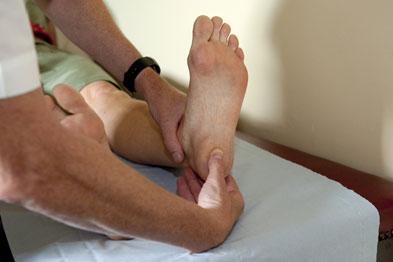
- Tender to a thumb press on the inside of the heel — that medial calcaneal tubercle, exquisitely so.
- Often one-sided. That fact alone is the loudest clue in the whole presentation, and almost nobody asks the right follow-up question about it.
Why Most Plantar Fasciitis Treatment Fails
The cookie-cutter algorithm runs the same way at almost every primary care office, urgent care, and walk-in podiatry chain in this country: stretch, ice, NSAIDs, drugstore inserts. If that does not work in six weeks, custom orthotics. If that does not work in three months, cortisone. If that does not work in nine months, a surgical consult.
That algorithm has roughly a 70% success rate. The 30% it leaves behind is the patient who has been suffering for a year, has spent thousands of dollars, and is being told their last option is to have a piece of their plantar fascia cut. That patient is almost always missing the same diagnosis — and it is not in the foot.
The plantar fascia is the last link in a kinetic chain that starts at your pelvis. When a provider treats the fascia alone, they are sanding the floor while ignoring that the house is tilted. The four upstream drivers I see most often, in order of clinical importance:
Pelvic rotation and functional leg-length discrepancy. This is the single most overlooked piece. The sacroiliac joints can rotate independently — one side rotating anterior, the other posterior — and when they do, the pelvis behaves like a slightly tilted countertop. One leg now functions longer than the other, often by 3 to 8 millimeters. With every step, the body compensates: more weight transmitted through one leg, asymmetric pronation, asymmetric calcaneal angle on heel strike, and asymmetric tensile load on one plantar fascia for every single step you take. Twelve thousand steps a day at an extra few percent of load on one side is exactly the recipe for unilateral plantar fasciitis that will not resolve. No amount of foot stretching fixes a rotated sacrum.
Tight gastrocnemius and soleus. A tight calf shortens the Achilles, restricts ankle dorsiflexion, and tilts the calcaneus into a position that pre-tensions the plantar fascia even before you put weight on it. Often this calf tightness is itself a compensation — the body locking down the lower leg to stabilize a pelvis it cannot trust. Stretching the calf without correcting the pelvis is sanding the floor again.
Pronation collapse. When the medial longitudinal arch collapses on weight-bearing — flat feet, fallen arches — the plantar fascia gets stretched on every step. This is a real driver, but it is also frequently secondary to weakness up the chain.
Gluteus medius weakness. Weak hip abductors let the femur drop inward (adduct and internally rotate), the knee follows into valgus, the tibia internally rotates, and the foot pronates more aggressively to compensate. The fascia overloads on every step. The original problem is in the hip, not the foot.
The pattern is consistent: pelvis → hip → knee → ankle → foot. Each link influences the next. Most providers stop at the foot, treat the foot, and watch the foot fail to heal. The fascia is not failing because it is weak. It is failing because it is the end of a chain that is loading it wrong.
The Pura Vida 60-Second Self-Assessment
Five tests, under two minutes total, that will tell you whether you are an isolated-fascia case or a chained-up-the-line case. This is not a diagnosis — it is a strong hint about which lane you fall into.
1. Mirror hip-height check. Stand barefoot in front of a full-length mirror, feet hip-width apart, equal weight on both feet, arms relaxed. Look at the tops of your hip bones (the iliac crests) and the waistband of your pants. Is one side noticeably higher than the other? Is one buttock crease higher than the other? Asymmetry here is a strong indicator of pelvic rotation.
2. Supine leg-length check (partner needed). Lie flat on your back on a firm surface, legs straight, ankles together. Have a partner pull both legs gently and equally by the ankles, then look at the inside ankle bones (medial malleoli). Is one ankle visibly farther down than the other? A 1/4-inch to 1/2-inch discrepancy is common in pelvic rotation patients and is the single best at-home indicator that your foot pain has a pelvic driver.
3. Calf-length test (knee-to-wall). Stand facing a wall, big toe of one foot four inches from the baseboard. Bend the knee straight toward the wall, keeping the heel flat on the floor. Can the knee touch the wall without the heel lifting? Repeat on the other side. If you cannot get within 4 inches, or if one side is significantly tighter than the other, your calf is contributing.
4. Single-leg balance. Barefoot, eyes open, balance on one foot for 30 seconds. Then the other. Wobbly, falling off in under 15 seconds, or one side dramatically worse than the other? That is gluteus medius and ankle stabilizer weakness — the upstream driver feeding pronation.
5. Pain-pattern check. Honestly: is your pain only the first few steps in the morning and after rest, easing within five minutes? Or does it persist most of the day, worsen with prolonged standing, and ache at rest? Pure first-step pain = earlier, more reversible picture. Persistent all-day pain = chronic degenerative plantar fasciosis, usually with upstream drivers.
Interpretation:
- All five tests normal, pure first-step pain → likely an isolated, early-stage plantar fasciitis. Conservative home care has an excellent chance.
- Hip heights uneven OR supine leg-length discrepancy OR one-sided pain → almost certain pelvic-rotation pattern. No amount of foot work will fully resolve this. Get the SI joint and sacrum evaluated.
- Tight calf test + collapsed arch → mechanical foot overload. Foot work will help, but check the hip and pelvis first to make sure the collapse is not being driven from above.
- Failed single-leg balance + weak hip → glute medius weakness driving pronation. Stretching will not fix this; you need targeted strengthening.
The Pura Vida Plantar Fasciitis Protocol
The first visit assembles a complete picture: feet, calves, knees, hips, sacroiliac joints, pelvis, and the dural connection up to the cranium. The treatment plan is built off what we find, not a one-size script. The elements I use most often:
SOT Category 2 pelvic blocking. This is where Sacro-Occipital Technique shines over generic chiropractic. Category 2 is the SOT designation for sacroiliac joint dysfunction with rotational instability — exactly the pattern that drives functional leg-length discrepancy and asymmetric plantar fascia load. The correction uses padded wedge blocks placed under the pelvis in a specific configuration, and gravity performs the adjustment over several minutes. There is no popping, no high-velocity thrust — just precise correction of the rotational pattern at the joint where the asymmetry originates. For a chronic one-sided plantar fasciitis patient, this is frequently the single most important intervention in the entire protocol. Patients are often surprised when their heel pain begins to ease within days of the first SI correction, before any treatment has touched the foot itself.
Cervical and cranial work for dural tension. The dural membrane wrapping the spinal cord runs continuously from the sacrum to the inside of the skull. Asymmetric dural tension up high creates traction down low. When indicated, cranial chiropractic work releases that tension at the source and removes a mechanical pull on the entire posterior chain — including the calf and plantar fascia.
Class IV laser therapy. Class IV laser delivers therapeutic light deep into tissue to reduce inflammation in the acute phase, boost cellular ATP, and accelerate collagen remodeling at the microtear sites in the calcaneal insertion. I treat three zones in a single session: the medial calcaneal insertion of the plantar fascia, the plantar fascia along the arch, and the gastrocnemius/soleus belly in the calf — because the calf is part of the problem. Typical course: 8 to 12 sessions over 4 to 8 weeks. Most patients feel a measurable change in first-step pain by visit 4.
acoustic wave therapy (extracorporeal shockwave) therapy. acoustic wave therapy is unfocused extracorporeal shockwave therapy — broad acoustic pulses that stimulate stem-cell migration, neovascularization (new blood vessel growth) in the degenerated tissue, and tissue regeneration. This is the modality I reach for when plantar fasciitis has crossed the 12-week mark into chronic plantar fasciosis. The shockwaves create controlled micro-trauma that essentially restarts the failed healing process the body abandoned months ago. Most chronic patients need 3 to 5 acoustic wave therapy sessions, and the relief is typically lasting because the underlying tissue actually heals — it is not a symptom modulator.
The home protocol. What you do between visits matters as much as what happens in clinic. The Pura Vida home protocol for plantar fasciitis:
- Nightly epsom salt foot bath. Follow the recipe in our epsom salt foot bath guide — 2 cups epsom salt, 1/2 cup baking soda, hot water, 20 minutes. The warm vasodilation and magnesium-driven muscle relaxation make this one of the highest-yield single home interventions for plantar fasciitis.
- Frozen water bottle roll — 60 seconds, before the foot bath, not after. Cold first to calm the irritated insertion, then warm to soften the fascia and calf for stretching. The cold-then-warm sequence is more effective than either alone.
- Calf wall stretch, two versions, 2 minutes each, after the bath. Knee-straight version targets the gastrocnemius; knee-bent version isolates the soleus. Both matter. Switch sides.
- Plantar fascia stretch — towel pull and big-toe extension. Sitting, loop a towel around the ball of the foot and pull gently to dorsiflex the foot and toes together for 30 seconds, five rounds. Then with the foot crossed over the opposite knee, grip the big toe and pull it back toward the shin for 30 seconds — this isolates the fascia directly.
- Glute medius strengthening. Side-lying clamshells (15 reps per side), monster walks with a resistance band (10 steps each direction), single-leg bridges (10 per side). Daily. This is the strengthening piece almost nobody does, and it is the difference between fixing the pattern and merely calming it.
- Footwear honesty. When you are on hard floors — kitchen, garage, concrete — you wear supportive shoes, period. No barefoot, no flip-flops, no flat slippers. Stiff-soled, arch-supportive shoes from the moment your feet hit the floor in the morning until you get back into bed.
- Night splint — acute phase only. A boot or sock-style night splint that holds the ankle at 90 degrees prevents the overnight plantarflexed shortening that causes the morning ice-pick. Use it for 4 to 6 weeks during the acute phase, then wean off. Long-term splint use does not improve outcomes and is uncomfortable enough that most patients abandon it.
Realistic timeline. Early-stage plantar fasciitis with no chronic degeneration usually resolves in 4 to 6 weeks with conservative care. Chronic plantar fasciosis — the 6-months-and-counting picture — typically takes 6 to 12 weeks on the full Pura Vida protocol, with acoustic wave therapy delivering the inflection point around weeks 4 to 6. Patients who have failed every other conservative approach often respond once the pelvic component is corrected and the actual failed tissue is treated with laser and shockwave instead of being asked to "rest."
Why Surgery Is Almost Never the Answer
There is a procedure called plantar fascia release — surgical cutting of part of the fascial band to relieve tension at the calcaneal insertion. Endoscopic versions exist. Partial-release versions exist. They all share a common reality: the fascia is a load-bearing structure, and cutting it has consequences.
The published satisfaction rate for plantar fascia release is somewhere in the range of 50 to 70 percent. That sounds like a coin-flip, and clinically it is. The procedure can produce a new problem called lateral column overload — once the medial fascia is released, weight shifts to the outside of the foot, and patients develop a midfoot ache that is sometimes worse than the original heel pain and considerably harder to fix. The fascia is part of the arch-support system; cutting it can destabilize the foot in ways that take years to compensate around.
By comparison, a well-executed conservative protocol that addresses the pelvis, the calf, the hip, and the fascia itself resolves roughly 85 to 90 percent of plantar fasciitis cases inside 6 to 12 weeks. The math is not close.
Surgery is a reasonable conversation when:
- The case is genuinely chronic — 12 months or more.
- The patient has failed at least three different well-executed conservative protocols that included treatment of upstream drivers, not just foot-focused care.
- Imaging confirms a structural lesion (full-thickness tear, intractable heel spur with mechanical impingement) that mechanically explains the persistence.
If you are heading toward a surgical consult, the one question worth asking your podiatrist or foot-and-ankle surgeon is: "Has anyone evaluated my sacroiliac joints, my pelvis, and my hip strength to make sure the foot is actually where the problem lives?" A surgeon who respects that question is one you can trust. A surgeon who waves it off is one whose surgery is likely to disappoint.
The San Antonio-Specific Angle
I see a lot of plantar fasciitis in this city, and the patterns are predictable.
Hot pavement and barefoot walkers. San Antonio summers run 100°F-plus for stretches that turn driveways and pool decks into griddles. Patients walk barefoot from the back door to the patio, from the car to the front porch, around the house on tile. Hard, unforgiving, sometimes scalding surfaces with no arch support. Months of that and the fascia gives.
Service industry and trades on their feet 10+ hours a day. Restaurant servers, line cooks, ER and ICU nurses, hospital techs, retail managers, mechanics, plumbers, electricians, construction crews. These patients cannot just "rest the foot." They need a protocol that lets them keep working while the fascia heals. The supportive-footwear, taping, and structural correction pieces become non-negotiable.
Riverwalk and hospitality workers. Tour guides, hotel staff, restaurant workers, museum docents, riverboat crews. Long shifts on flat, hard surfaces in shoes chosen for uniform code rather than support. Tourists walking all day from the Alamo to the Riverwalk to the Pearl in flip-flops or unfamiliar shoes are another major patient population — often presenting on day three of their trip.
Auto-injury patients with secondary plantar fasciitis. After a motor vehicle accident, patients often develop a compensatory gait that asymmetrically loads one foot. Months later they show up with classic one-sided plantar fasciitis that did not exist before the crash. The cause is upstream — pelvic rotation from the impact — and the treatment is comprehensive auto-injury chiropractic care, not foot-only intervention.
Spanish-speaking working patients often present late. A line cook or a construction crew lead cannot easily miss a shift, so foot pain gets pushed through for months. By the time they come in the picture is chronic degenerative plantar fasciosis with significant pelvic compensation. We provide doctor-level English and Spanish at every visit so language is never the reason care is delayed.
Frequently Asked Questions
Why is my plantar fasciitis only on one side? This is the most diagnostically important question patients ask, and it almost never gets the right answer in a foot-focused workup. One-sided plantar fasciitis is overwhelmingly the result of asymmetric load — pelvic rotation, functional leg-length discrepancy, gait compensation from a prior injury, or unilateral hip weakness. The fascia on the "loaded" side is taking more force every single step. Treating that fascia without correcting the asymmetry is why your one-sided pain has not resolved.
Can I just buy custom orthotics? Custom orthotics can help, but they are a passive support, not a correction. They cradle the foot so the fascia is less stressed during weight-bearing, which buys symptom relief. They do nothing for a rotated pelvis or weak glute medius driving the load asymmetrically in the first place. Many of my patients keep wearing their orthotics during care — they are not harmful — but the orthotic alone is rarely the answer, especially in chronic cases.
How long until I should feel better? For early-stage cases (under 3 months), expect a noticeable reduction in first-step morning pain within 2 to 3 weeks of starting the full protocol. For chronic cases (6 months or longer), the curve is slower — measurable change usually by week 4, clear trajectory by week 6, often full resolution by weeks 8 to 12. acoustic wave therapy delivers the biggest single jump for chronic cases, typically around session 2 or 3.
Will rolling on a tennis ball or lacrosse ball fix it? Ball rolling can provide short-term symptom relief by mobilizing the fascia. It will not fix a structural pattern, and aggressive rolling on a sharply painful insertion can actually inflame an already degenerated tissue and prolong the picture. Use it gently as a comfort measure, not as a cure.
Is plantar fasciitis the same as a heel spur? No, though they often coexist. A heel spur is a small bony outgrowth on the underside of the calcaneus, visible on x-ray. About 50 percent of plantar fasciitis patients have a heel spur, but so do many people with no foot pain at all. The spur is the result of chronic fascial pull on the bone, not the cause of the pain. Removing the spur does not reliably resolve the pain because the spur was never the actual problem.
Do I need an MRI? For typical plantar fasciitis, no. Diagnosis is clinical. MRI is reasonable if the picture is atypical, if there is no response to a 6 to 8 week well-executed conservative trial, or if I am ruling out a partial fascial tear, calcaneal stress fracture, or tarsal tunnel syndrome that can mimic plantar fasciitis. Ultrasound is also a reasonable, lower-cost option that can show fascial thickening.
Should I keep running? This is a case-by-case conversation. Generally — reduce volume and intensity by at least half, switch to softer surfaces (a track or treadmill instead of concrete), wear supportive running shoes that are less than 300 miles old, and never run through morning first-step pain that is getting worse week over week. Many of my runners can continue training in some form while we treat the underlying drivers; pure rest is rarely necessary and often counterproductive.
What about cortisone injections? Cortisone into the plantar fascia reliably reduces inflammation and often improves symptoms for 6 to 12 weeks. Trade-off: it is a symptom modulator, not a fix. Repeated injections — more than two or three lifetime — can weaken the fascia and increase the risk of a full-thickness rupture, which is a much worse problem than the original plantar fasciitis. Useful for getting through a specific event (wedding, vacation, marathon). Not a long-term strategy.
Is the boot at night really necessary? For severe morning pain, yes, during the acute phase. The boot holds the ankle at 90 degrees so the fascia cannot shorten overnight, which is what causes the first-step ice pick. Use it for 4 to 6 weeks during the worst of the picture, then wean off. Long-term night splint use does not improve outcomes and most patients give up on it within a week anyway.
Can chiropractic help if I've already had plantar fascia release surgery? Yes, and you are exactly the patient who needs the upstream evaluation that did not happen before surgery. We address the pelvic, hip, and calf components that were likely driving the original problem, support recovery of any lateral column overload, and use Class IV laser and acoustic wave therapy to optimize the post-surgical tissue. Many post-surgical patients do meaningfully better once the structural pattern that caused the original failure is finally corrected.
Ready to Find Out What's Actually Driving Your Heel Pain?
If you have been treating your plantar fasciitis like a foot problem for months and it has not resolved — let's check the pelvis, the hip, and the calf. The most common reason chronic plantar fasciitis does not heal is that nobody has looked above the ankle.
I see patients from across San Antonio — Stone Oak, Castle Hills, Alamo Heights, Helotes, the Medical Center, the Northwest Side, and the surrounding suburbs. Pura Vida is at 2318 NW Military Hwy, Suite 103, San Antonio TX — just inside Loop 410.
- Phone: (210) 685-1994
- Free consultation for new patients: Book here
- Online scheduling: Book now
Consultations and care are conducted in English or Spanish — I am a fully bilingual Doctor of Chiropractic (Doctor en Quiropráctica).
Dr. Dan Foss, DC, is Advanced SOT-certified — the only Advanced SOT certification in the San Antonio area — and Webster Technique certified, 23+ years in practice. See his verified clinical outcome.
Related reading: Epsom salt foot bath recipe · Sciatica chiropractor in San Antonio · Carpal tunnel chiropractor · SOT chiropractic · Cranial chiropractic · Class IV laser · acoustic wave therapy · Auto-injury chiropractor