Frozen Shoulder: Why It Happens, Why Stretching Harder Makes It Worse, and What Actually Helps
Adhesive capsulitis explained by Dr. Dan Foss, DC — the three phases, why aggressive stretching backfires, the diabetes connection, and the SOT and CMRT approach. San Antonio. (210) 685-1994.
On this page
Frozen shoulder is the only musculoskeletal condition I regularly see where the patient's own effort is making it worse.
That's not a criticism of the patient — it's the logical result of the advice they were given. Someone with a shoulder that won't lift is almost always told to stretch it, so they push into the restriction daily, hard, and the shoulder gets angrier and tighter. Six months later they can't reach a seatbelt, and they've concluded they're doing something wrong.
They're not. They're stretching a joint capsule that is actively inflamed and laying down scar tissue. Force applied at the wrong phase doesn't restore motion. It recruits more guarding.
What Adhesive Capsulitis Actually Is
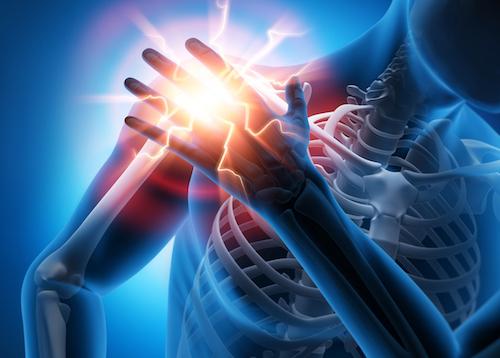
The medical name tells you more than "frozen shoulder" does. The glenohumeral joint — the ball-and-socket of your shoulder — sits inside a fibrous sleeve called the joint capsule. In adhesive capsulitis that capsule becomes inflamed, then thickens and contracts, and adhesions form. A sleeve that should be loose and generous becomes a tight, shrunken bag holding the joint hostage.
This is a capsule problem, not a muscle problem — and that distinction matters, because the strategies that work on a tight muscle are the wrong tools for a contracting capsule.
It also explains the most useful diagnostic sign: frozen shoulder restricts motion in every direction, and it restricts it passively. If someone else lifts your relaxed arm and it still stops short, that's capsular. If your arm moves fine when someone else lifts it but hurts when you lift it yourself, you're likely dealing with shoulder impingement or a rotator cuff problem, which behave very differently.
The Three Phases, and Why Timing Is Everything
Frozen shoulder moves through phases, and treatment that helps in one can set you back in another.
Phase 1 — Freezing
Pain leads. It's often worse at night and at rest, and range of motion is gradually shrinking. The capsule is inflamed and reactive. This phase can run for many months, and it frequently begins after a period of reduced movement — an injury, a surgery, a sling, or just protecting a sore shoulder.
This is the phase where aggressive stretching does damage. Loading inflamed tissue into pain provokes more inflammation and more protective guarding. Care here should calm the joint down, not force it open — gentle motion within a pain-free range, inflammation management, and addressing everything around the shoulder that's compensating.
Phase 2 — Frozen
Pain settles somewhat; stiffness dominates. The capsule has contracted and the joint is genuinely mechanically restricted. This is where graded mobilization earns its keep, because you're working on established tissue change rather than active inflammation.
Phase 3 — Thawing
Motion gradually returns and the capsule remodels. This can take a long time, and while frozen shoulder is often described as self-limiting, many people are left with lasting deficits — particularly in external rotation and reaching behind the back. That residual loss is where good care makes the difference between "mostly better" and "back to normal."
The Metabolic Connection Almost Nobody Mentions
Here is the part that surprises patients: frozen shoulder is markedly more common in people with diabetes. It's also associated with thyroid disease. These associations are well established.
That's not bad luck. Connective tissue behaves differently when blood sugar is dysregulated — collagen cross-links differently and remodeling is altered. A capsule in that environment is more likely to fibrose and slower to release.
This is why I don't treat a frozen shoulder as a shoulder. Pura Vida's premise is that the spine, the organs, and the cranium function as one system, and this condition illustrates it cleanly. Alongside the joint work, we screen the CMRT reflexes for the pancreas and liver and the thoracic segments carrying their autonomic supply — the territory I covered in the diabetes, pancreas, and spine connection.
To be clear about what I'm not claiming: chiropractic care does not treat diabetes or thyroid disease, and if you have either, your physician manages it. What I can say is that the metabolic context changes how a shoulder behaves and how long it takes. If you have unexplained shoulder stiffness and haven't had your blood sugar checked recently, that's worth a conversation with your doctor.
One more differential: not all shoulder pain starts in the shoulder. Gallbladder and liver referral can present as right shoulder pain — see the liver, gallbladder, and right shoulder. Sudden shoulder or arm pain with chest pressure, shortness of breath, or nausea is a medical emergency, not a chiropractic visit.
What We Actually Do at Pura Vida
Evaluation establishes the phase first, because that determines everything else. Then:
- Confirm it's capsular. Passive range of motion in all planes, with attention to external rotation, which is typically lost early and lost worst.
- Treat the thoracic spine and scapula, not just the shoulder. Lifting your arm overhead requires your mid-back to extend and your shoulder blade to rotate on the rib cage. When the shoulder is locked, those regions stiffen from disuse and steal whatever motion you had left. Restoring them often produces the first real functional gain, before the capsule changes at all.
- Low-force adjusting. SOT uses pelvic blocking and gentle sustained contacts rather than forceful thrusting. On a guarding shoulder that's not just a preference — high-force manipulation of a reactive capsule is how you extend the freezing phase.
- CMRT reflex work on the pancreas, liver, and diaphragm reflexes, with the related thoracic segments.
- Modalities by phase. Class IV laser therapy for inflammation, and acoustic wave therapy where fibrotic tissue is a factor — in the frozen and thawing phases, not during acute inflammation.
- A home program matched to your phase, which in the freezing phase means doing less than you think you should.
We coordinate with physicians when a case isn't moving. Corticosteroid injection, hydrodilatation, and in stubborn cases surgical release are legitimate options, and there's no ego in saying so. What I'd rather avoid is someone spending a year stretching into pain and losing more motion.
Frequently Asked Questions
How long does frozen shoulder last? Longer than most people expect — typically many months through the full three-phase course, sometimes well over a year. Care won't make the phases vanish, but it can reduce how much motion you lose in the freezing phase and how much deficit you're left with at the end. Anyone promising a quick fix is selling something.
Should I push through the pain when stretching? No — and this is the most important thing on this page. In the freezing phase, pushing into pain provokes more inflammation and more guarding. If your shoulder is worse the night after you exercise it, you're doing too much.
Can a chiropractor help frozen shoulder? A chiropractor can address the joint restriction, the thoracic and scapular mechanics overhead motion depends on, and the segmental and reflex contributors — and can tell you which phase you're in so your own efforts aren't counterproductive. What no one can do is force a capsule open on a schedule.
Do I need an MRI? Frozen shoulder is usually a clinical diagnosis based on the pattern of restriction. Imaging is more useful for ruling out a rotator cuff tear or significant arthritis, particularly if the presentation doesn't fit or isn't following the expected course.
If Your Shoulder Has Been Getting Worse for Months
The patients who do best stop fighting the shoulder and start working with where it actually is — knowing the phase, treating the whole chain rather than the sore spot, and being patient in a way this condition genuinely demands.
We see patients across San Antonio — Castle Hills, Shavano Park, Stone Oak, Alamo Heights, Olmos Park, and Helotes — in English and Spanish. More on our frozen shoulder page, or on related presentations in shoulder pain, bursitis, and tendonitis.
Call (210) 685-1994 or book a free consultation. We're at 2318 NW Military Hwy Suite 103, San Antonio, TX 78231.