Carpal Tunnel Syndrome: A San Antonio Chiropractor's Guide to Why Your Wrist Surgery Might Be Wrong | Pura Vida
A San Antonio chiropractor's complete carpal tunnel guide: why surgery fails 30%+ of patients, the cervical-thoracic 'double crush' nobody checks, the SOT and Class IV laser protocol that resolves most cases without surgery, and the self-test that tells you if you're a candidate for conservative care.
On this page
It is 3:17 in the morning and your hand is asleep again. Not pins-and-needles asleep — dead asleep. Thumb, index, middle, and the radial half of the ring finger feel like they belong to someone else. You dangle the hand off the side of the bed, shake it like you are flicking water off, and the tingling comes back as a hot wave of pinprickles. Third time this week.
A few months go by. Now it happens during the day — gripping the steering wheel on Loop 410, blow-drying your hair, holding your phone. You drop a coffee mug because the pinch grip is not what it used to be. You see your PCP. She moves your wrist, taps the front of it, has you press the backs of your hands together — and says it looks like carpal tunnel. You leave with "surgical consult" in your visit summary.
You google "carpal tunnel" on the drive home and the first ten results say the same thing: rest, brace, anti-inflammatories, cortisone, surgery. None mention your neck, your first rib, your shoulder, the way you sleep with your arm curled under the pillow, or the C6-C7 disc bulge nobody has ever checked.
I am Dr. Dan Foss, DC, of Pura Vida Chiropractic in San Antonio — 23+ years in practice, the only Advanced SOT-certified chiropractor in the San Antonio area, and Webster Technique certified. This is what carpal tunnel actually is, the single most underdiagnosed reason wrist surgery fails, and the conservative-care protocol that resolves most cases without a scalpel. I will also tell you, plainly, when surgery is the right call.
What Carpal Tunnel Syndrome Actually Is
The carpal tunnel is exactly what the name says — a tunnel. The floor and walls are the eight small carpal bones of the wrist, arched into a half-pipe. The roof is a thick fibrous band called the transverse carpal ligament (or flexor retinaculum). The canal is about the width of your thumb at the base of your hand.
Ten structures share that small space: nine flexor tendons running from your forearm out to your fingers, and one median nerve — the nerve that supplies sensation to the palm side of the thumb, index, middle, and radial half of the ring finger, and that drives the thenar muscles at the base of the thumb.
No extra room. When anything in the tunnel swells — tendons inflamed from repetitive load, fluid retention from pregnancy or thyroid issues, post-traumatic edema, synovial thickening — the median nerve is what loses first. Nerves are softer than tendons. When the nerve is compressed long enough, two things happen in sequence:
- The nerve loses its blood supply. This is the night-time numbness phase. Sleep positions that flex the wrist (curled fist, hand under cheek, arm tucked under the pillow) shrink the tunnel further and the nerve goes ischemic. You wake at 3 a.m. with a dead hand, shake it back to life, fall asleep, repeat.
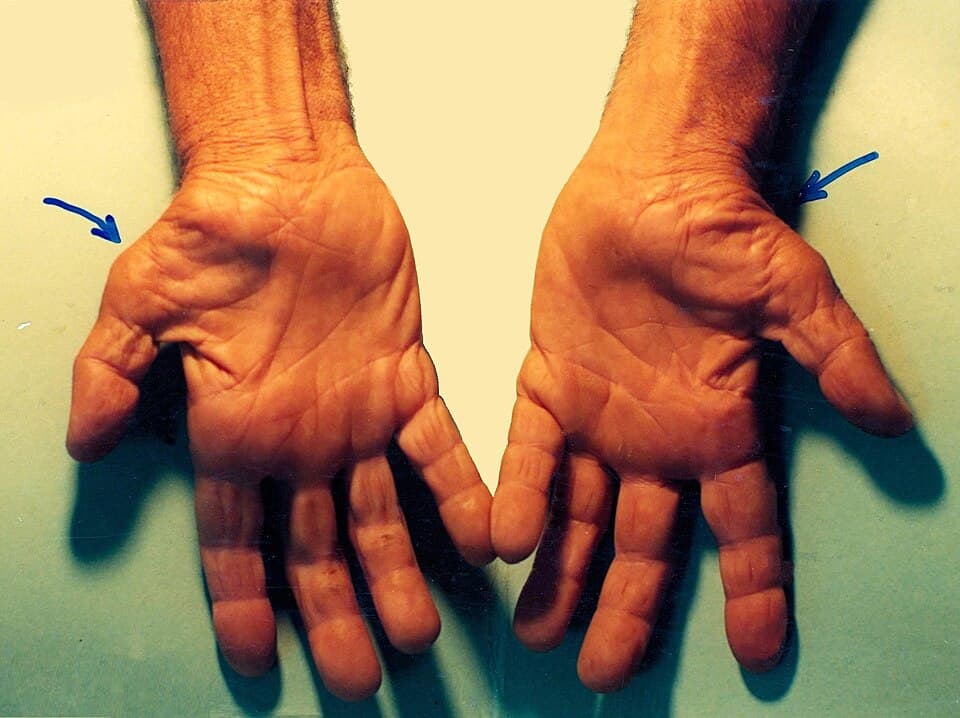
- The nerve itself begins to degenerate. This is Wallerian degeneration — actual structural axonal damage downstream of the compression point. Symptoms shift from intermittent numbness to constant numbness, weak pinch grip, dropped objects, and eventually thenar atrophy — visible wasting of the thumb-base muscle. This is late-stage CTS, and the phase where conservative care has the hardest time fully reversing the picture.
The two classic in-office tests:
- Phalen test — press the backs of your hands together with wrists fully flexed for 60 seconds. Positive if numbness or tingling reproduces in the median distribution.
- Tinel sign — tapping over the median nerve at the front of the wrist produces an electric "zing" into the fingers.
Both are sensitive but not specific. A positive Phalen or Tinel does not prove the compression is at the wrist. That is the crack in the standard diagnostic story.
The "Double Crush" Nobody Talks About
In 1973, Upton and McComas published a paper in The Lancet called "The Double Crush in Nerve-Entrapment Syndromes." The observation, confirmed by every decade of follow-up research since: a peripheral nerve compressed at two points along its length is more symptomatic than a nerve compressed at one point — and surgery at only one of the compression points often fails to resolve the symptoms. That paper is more than fifty years old. The standard CTS workup still looks at the wrist, and only the wrist.
The median nerve does not start at your wrist. It starts at the cervical spine — the nerve roots of C5 through T1, which merge into the brachial plexus at the front of the shoulder, then divide into the three major arm nerves. The median nerve travels from the plexus down the arm, through the elbow and forearm, and finally through the carpal tunnel into the hand.
Anywhere along that 24-inch pathway, it can be compressed. The most common spots besides the wrist:
Cervical disc or facet compression at C6-C7 (also C5-C6, C7-T1). A bulging or degenerated disc in the lower neck irritates the nerve root feeding the median nerve. Patients often have no neck pain — the symptom is in the hand, the source is in the neck. Cervical radiculopathy presenting as CTS is missed constantly.
Scalene compression at the front of the neck. The brachial plexus threads between the anterior and middle scalenes. Tight scalenes — common with forward-head posture, mouth-breathing, or post-whiplash — squeeze the plexus. This is the most common form of thoracic outlet syndrome (TOS) and reproduces CTS symptoms almost perfectly.
Pectoralis minor compression under the collarbone. The neurovascular bundle passes under the pec minor on its way to the armpit. A tight pec minor — common in desk workers, drivers, breastfeeding mothers — compresses the bundle. Another variant of TOS.
First rib elevation. The first rib sits just under the collarbone, and the plexus passes directly over it. An elevated first rib pinches the plexus against the clavicle every time you raise your arm.
Pronator teres at the elbow. The median nerve passes between the two heads of the pronator teres. Repetitive gripping (mechanics, dental hygienists, musicians) can hypertrophy this muscle and trap the nerve — often looking exactly like CTS.
Now the math. A nerve compressed only at the carpal tunnel often responds to wrist release. A nerve compressed at the cervical disc and the carpal tunnel has two problems. Surgery gives the distal nerve more room — but the proximal compression is still there. The patient is told "the surgery was successful but the symptoms persist," which translates to we operated at the wrong level. Long-term follow-up studies of carpal tunnel release consistently show 20–30%+ of patients have persistent or recurrent symptoms beyond year one — and one of the strongest predictors is unaddressed cervical or thoracic outlet contribution.
The first question I answer for a CTS patient is not "do you have CTS?" It is "where, along the entire pathway from your neck to your fingers, is this nerve being compressed?"
The 60-Second Self-Screen
You can do this at home in under two minutes. Not a diagnosis — a strong hint about whether your symptoms come purely from the wrist, or there is a proximal component to address before anyone discusses surgery.
1. Phalen test. Press the backs of your hands together at chest level, fingers down, wrists fully flexed, 60 seconds. Positive if numbness or tingling reproduces in the thumb, index, middle, or radial half of the ring finger.
2. Reverse Phalen / prayer test. Press palms together, fingers up, wrists fully extended, 60 seconds. Positive if median symptoms reproduce.
3. Tinel sign. Lightly tap the front of the suspect wrist over the crease. Positive if you get an electric "zing" into the fingers.
4. Upper Limb Tension Test (ULTT) for the median nerve. Stand. Hold the suspect arm out to the side at shoulder height, palm forward, elbow straight. Bend the wrist back. Tilt your head away from that arm. Positive if you reproduce your hand symptoms — that is the median nerve on stretch all the way from the neck. If symptoms ease when you tilt your head toward the affected arm, the proximal nerve is involved.
5. Cervical compression / Spurling test (gentle, partner-assisted). Sit. Tilt your head toward the symptomatic side and have a partner press gently straight down on the top of your head. Positive if hand or arm symptoms reproduce. Skip if you have significant neck pain, dizziness, or known disc disease.
Interpretation:
- Only wrist tests positive → likely isolated CTS. Conservative wrist-focused care has an excellent chance.
- Wrist tests AND ULTT positive → likely double crush. Wrist surgery alone will likely disappoint.
- Wrist tests AND Spurling positive → cervical contribution is almost certain. Get the cervical spine evaluated before any surgical decision.
- ULTT or Spurling positive but wrist tests negative → may not be CTS at all — may be cervical radiculopathy or TOS masquerading as CTS.
The Pura Vida Conservative-Care Protocol
The first visit assembles a complete picture: wrist, elbow, shoulder, first rib, cervical spine, cranium, pelvis, and how you sleep, sit, and work. Treatment is built off that picture, not a one-size script. The elements I use most often:
SOT cervical and cranial work. Sacro-Occipital Technique treats the body as a connected unit through the dural membrane system that runs from sacrum to skull. The dural sleeve wrapping the spinal cord is continuous with the connective tissue wrapping the brachial plexus and median nerve. Asymmetric dural tension at the top of the spine creates traction along the entire median nerve pathway — the nerve is being pulled tight before it ever reaches the wrist. Cranial chiropractic work releases that tension at the source.
Specific adjusting of the cervical-thoracic junction, first rib, and clavicle. C7-T1 is where the lower brachial plexus roots exit; a restricted segment here directly compresses the nerve supply to the hand. The first rib is the most underadjusted bone in the body for upper-extremity complaints — when elevated, it pinches the plexus against the underside of the clavicle every time you raise your arm. A fixated clavicle does the same. These three adjustments alone resolve a meaningful percentage of "carpal tunnel" cases, because the compression was never at the wrist.
Class IV laser therapy. Class IV laser delivers therapeutic light deep into tissue to reduce inflammation, boost cellular ATP, and speed nerve healing. I use it at two targets: the carpal tunnel itself and over the cervical nerve roots. Typical course: 6 to 12 sessions over 4 to 8 weeks. Most patients feel a measurable change by visit 4.
acoustic wave therapy. acoustic wave therapy is unfocused extracorporeal shockwave therapy — broad acoustic pulses that stimulate stem-cell migration, neovascularization, and tissue regeneration. For stubborn CTS with chronic synovial thickening or nerve-sheath fibrosis, acoustic wave therapy is often the tipping point, applied directly over the median nerve at the wrist and along its course in the forearm.
Nerve flossing (neurodynamic glides). Gentle movement sequences that glide the median nerve through its compression points without stretching it. I teach the technique in clinic for twice-daily home use. Done right, it improves intraneural blood flow and reduces adhesions. Done wrong, it makes things worse — so I do not recommend YouTube versions.
Ergonomic correction. Most CTS is sustained by sleep position and workstation setup. Non-negotiables: a neutral-position wrist brace at night during the acute phase (one of the highest-yield single interventions), keyboard and mouse positioned so wrists rest neutral, monitor at eye level so you are not chin-poked forward (which loads the scalenes), and a stand-and-mobilize break every 30 minutes.
Anti-inflammatory support. Magnesium glycinate 200–400 mg/day, omega-3 fish oil 2–3 g/day, and vitamin B6 (pyridoxine) 50 mg/day with caution — B6 has historic clinical support in CTS, but chronic doses above 200 mg/day can cause sensory neuropathy, the opposite of what you want. Do not exceed the conservative dose without supervision.
Realistic timeline. Most mild-to-moderate CTS — intact strength, intermittent symptoms, no thenar atrophy — resolves in 6 to 12 weeks. The curve is usually nonlinear: inconsistent gains for two weeks, a corner turned around week 4–5, then steady progress. Severe CTS with thenar atrophy and significant denervation on EMG is harder; the honest conversation may include eventual surgery, in which case our care becomes pre- and post-surgical rehab to make the surgery actually stick.
When Surgery Is Actually the Right Call
Nothing destroys patient trust faster than a chiropractor who pretends surgery is never appropriate. Surgery is the right call when:
- Significant thenar atrophy — visible wasting of the thumb-base muscle. Late-stage motor denervation; the longer it persists, the less likely full recovery even after decompression.
- Conservative care has failed after a well-executed 3-month trial — real, consistent care that addressed both the wrist and the proximal pathway. Not "I wore a brace sometimes."
- Acute trauma to the carpal tunnel — wrist fracture with displaced fragments on the nerve, deep laceration, acute hematoma. May require urgent decompression.
- EMG/NCV shows severe denervation — prolonged distal motor latency, low compound muscle action potentials, axonal loss.
If you are heading toward a surgical consult, one question worth asking: "Have you evaluated my cervical spine and thoracic outlet to make sure the wrist is actually the right level to operate on?" A good surgeon will respect that question.
Pura Vida fits the surgical pathway two ways: as the conservative-care option before the surgical consult for the majority of CTS patients who do not need a scalpel, and as the post-surgical recovery team for the ones who do — laser, acoustic wave therapy, and SOT after release reduce scar adhesion, improve nerve regeneration, and address the cervical-thoracic pieces the surgery did not touch.
The San Antonio-Specific Angle
I see a lot of carpal tunnel in this city, and there are patterns.
Office workers — Northwest Side, Medical Center, USAA, the SAMSAT corridor. Eight hours a day of keyboard and mouse with wrists in mild extension, forward-head posture, tight pec minors. Classic desk-job CTS, almost always with a cervical-thoracic component nobody has checked.
Manufacturing and trades workers — Toyota, Caterpillar, construction. Repetitive gripping, vibration exposure from power tools, forearm hypertrophy. Often pronator teres involvement at the elbow on top of wrist pressure.
Dental hygienists, hairstylists, musicians. Sustained gripping and fine motor work for hours. Some of the most stubborn cases in my practice — these professionals cannot just "rest the wrist."
Mothers of young infants. The most often missed. Constant feeding load — cradle position for hours, pumping, lifting a 15-pound car seat one-handed — plus hormonal fluid retention produces an explosive incidence of postpartum CTS. We see this constantly in our prenatal and postpartum patients.
Auto-injury patients with CTS-like symptoms. San Antonio averages around 250 MVAs per day. Many post-crash patients show up months later thinking they have carpal tunnel. In many cases, it is not carpal tunnel at all — it is brachial plexus traction injury from whiplash, scalene spasm, first-rib elevation, or cervical disc injury. The treatment is not wrist surgery — it is comprehensive auto-injury chiropractic care addressing the cervical-thoracic structures that were actually injured.
Spanish-speaking patients often present late. Patients in restaurant, hospitality, or manufacturing roles where missing a shift is not an option push through night-time numbness for months or years. By the time they come in, the picture has progressed to constant, sometimes with early thenar atrophy. We provide doctor-level English and Spanish at every visit so language is never the reason care is delayed.
Frequently Asked Questions
Will my carpal tunnel go away on its own? Sometimes. Pregnancy CTS often resolves postpartum as fluid retention normalizes. Acute CTS from a specific overuse event may resolve with rest. Chronic CTS with a structural contribution does not heal itself — the compression is still there. Waiting once symptoms are constant or pinch grip is weakening is how you progress to the surgical category.
Is the wrist brace at night enough? A neutral-position night brace is one of the highest-yield single interventions in mild CTS, and for some patients it is enough. For most, it is necessary but not sufficient — the brace controls the wrist during sleep but does nothing for the cervical disc, first rib, or tight pec minor also compressing the nerve.
How is chiropractic for CTS different from physical therapy? Good PT for CTS is genuinely helpful — nerve glides, strengthening, ergonomics, modalities. The difference is structural correction. A PT generally does not adjust C6-C7, mobilize a stuck first rib, perform cranial work to release dural tension, or run SOT category protocols. The two professions are often complementary — many of my CTS patients see both.
How many visits before I should see improvement? Most patients feel a measurable change by visit 4–6. By visit 8–10 we expect a clear trajectory. If you are not responding by visit 8, we re-evaluate honestly — consider EMG/NCV and have a frank conversation about whether the pattern is consistent with conservative success or whether we need to involve a surgeon.
What if I have already had surgery and still have symptoms? You are exactly the patient the double-crush concept describes, and you are not unusual. We address the cervical, thoracic outlet, and first-rib components the wrist surgery did not touch — usually SOT, specific adjusting, Class IV laser at the cervical roots, and nerve flossing.
Is CTS covered by my insurance for chiropractic care? Most San Antonio insurance plans cover chiropractic for CTS at some level. We verify benefits before your first paid visit, and the new-patient consultation is free.
Can carpal tunnel come back after surgery? Yes, and one of the strongest predictors of recurrence is unaddressed proximal compression. If you had wrist surgery, were better for six months, and the symptoms came back — the most likely explanation is that the cervical-thoracic component was never addressed.
Should I get an EMG before trying conservative care? For mild-to-moderate CTS, no — start conservative care and add EMG/NCV later if you are not responding. For significant atrophy, constant numbness, or visible thumb weakness, the EMG first helps quantify severity and informs how long to trust conservative care.
What about cortisone injections? Cortisone into the carpal tunnel reliably reduces inflammation and often improves symptoms for weeks to months. Trade-off: short-term symptom modulator, not a fix. Repeated injections weaken local tendon and ligament. Useful for a specific deadline; not a long-term solution.
Can chiropractic help if my CTS is from pregnancy? Yes. Pregnancy CTS responds well to Webster Technique, upper-cervical and first-rib work, and conservative wrist management. Many cases resolve postpartum, but addressing it during pregnancy makes the late months dramatically more livable.
Ready to Find Out If Your CTS Is Actually a Carpal Tunnel Problem?
If you are heading toward a surgical consult and have not had your cervical spine, thoracic outlet, and first rib evaluated — let's have a conversation first. Surgery on the wrong level is the most preventable cause of a failed CTS surgery.
I see patients from across San Antonio — Stone Oak, Castle Hills, Alamo Heights, Helotes, the Medical Center, the Northwest Side, and the surrounding suburbs. Pura Vida is at 2318 NW Military Hwy, Suite 103, San Antonio TX — just inside Loop 410.
- Phone: (210) 685-1994
- Free consultation for new patients: Book here
- Online scheduling: Book now
Consultations and care are conducted in English or Spanish — I am a fully bilingual Doctor of Chiropractic (Doctor en Quiropráctica).
Dr. Dan Foss, DC, is Advanced SOT-certified — the only Advanced SOT certification in the San Antonio area — and Webster Technique certified, 23+ years in practice. See his verified clinical outcome.
Related reading: Auto-injury chiropractor · SOT chiropractic · Cranial chiropractic · Class IV laser · acoustic wave therapy · Trigeminal neuralgia & cranial SOT · Sciatica chiropractor in San Antonio