Thoracic Outlet Syndrome: The Reason Some Carpal Tunnel Surgeries Don't Work
Hand numbness that isn't carpal tunnel. Dr. Dan Foss, DC explains thoracic outlet syndrome, how the finger pattern tells them apart, and the vascular signs that need urgent care. San Antonio.
On this page
There's a specific patient I see more often than I'd like: someone who had carpal tunnel surgery, recovered from the incision, and still has a numb hand.
Sometimes the surgery was the wrong operation for the right symptoms. The nerve was being compressed — just not at the wrist.
Where the Thoracic Outlet Is
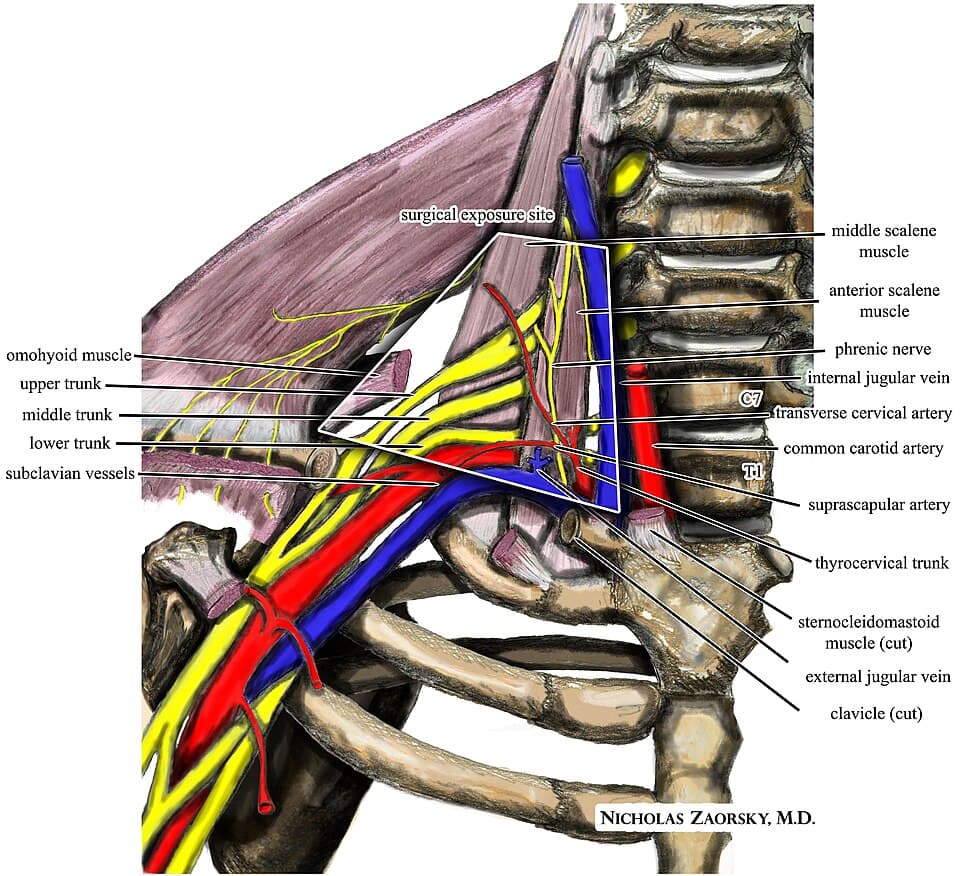
Between your collarbone and your first rib there's a narrow gap. Everything going to your arm passes through it: the brachial plexus, the bundle of nerves supplying the whole limb, plus the subclavian artery and vein. The scalene muscles on the side of your neck form the walls of the passage.
It's a tight space with no margin. Narrow it — by a rib sitting too high, scalenes locked in spasm, a badly healed collarbone fracture, or an extra rib you were born with — and the structures inside get squeezed.
That's thoracic outlet syndrome. The large majority of cases are neurogenic, meaning the nerves are compressed. A smaller number are venous or arterial, and those matter urgently — more below.
The Finger Pattern That Tells Them Apart
Here's the detail that sorts most of this out, and almost nobody gets told it.
Carpal tunnel compresses the median nerve at the wrist. Median territory is the thumb, index, middle, and thumb side of the ring finger. Classic carpal tunnel wakes you at night and you shake the hand to relieve it.
Thoracic outlet syndrome most often irritates the lower brachial plexus, and that territory is the opposite side of the hand — the little finger, ring finger, and inner edge of the forearm running up toward the armpit.
So if your numbness lives in the pinky and ring finger, or along the inside of the forearm, the wrist is unlikely to be the problem. Other features pointing to the outlet:
- Overhead activity brings it on. Reaching into a top cupboard, washing your hair, painting a ceiling — anything with the arms elevated closes the space further.
- Carrying makes it worse. A heavy shoulder bag, a toolbox, groceries — traction on the arm pulls the whole neurovascular bundle down against the first rib.
- The neck and shoulder are involved. Aching across the top of the shoulder and into the neck commonly travels with it.
- Hand fatigue and clumsiness with sustained use — dropping things, trouble with buttons — rather than pure pain.
Red Flags That Are Not Chiropractic Problems
This part is short and important. Vascular thoracic outlet syndrome involves the artery or vein rather than the nerves, and it needs medical evaluation rather than manual care.
Get urgent medical attention if you have:
- Sudden swelling of the whole arm, often with a bluish or purple discoloration. In a young, otherwise healthy person this can follow heavy overhead exertion and may indicate a clot in the subclavian vein.
- A hand that is cold, pale, or noticeably weaker in pulse than the other side.
- Symptoms that came on abruptly and are escalating.
None of that is a reason to see me first. Those are emergency-department and vascular-specialist findings, and I refer them immediately. I mention them because patients search "arm numbness" and land on chiropractic pages, and you deserve to know which column you're in.
Double Crush: Why Both Can Be True
The reason failed carpal tunnel surgery is such a recurring theme deserves its own explanation.
A nerve already compressed somewhere along its length tolerates a second compression less well than a healthy nerve would. So someone with a narrowed thoracic outlet develops genuine carpal tunnel symptoms more easily — and if only the wrist gets released, the compression higher up is still there when the bandage comes off.
This cuts both ways. Some patients have pure TOS misread as carpal tunnel. Others have both and need both addressed. What I'd caution against is assuming a diagnosis from where the symptoms are felt, because referred nerve symptoms are unreliable reporters of their own origin. If you've been told you have carpal tunnel syndrome, it's worth confirming the level before anyone operates.
What Narrows the Space in the First Place
Most neurogenic TOS is postural and mechanical, which is also why it's treatable.
Forward head and rounded shoulders. When the head sits forward of the shoulders, the scalenes work continuously to hold it up and the first rib gets pulled upward. Desk and phone use are the dominant drivers — the same mechanism behind text neck.
First rib restriction. The first rib should move subtly with every breath. Stuck in an elevated position, the outlet is permanently narrower than it should be.
Whiplash. Rapid acceleration-deceleration injures the scalenes along with everything else in the neck, and post-whiplash TOS appearing weeks later is common enough to belong on the table.
Repetitive overhead work, or a cervical rib. Stylists, painters, electricians, mechanics and swimmers are over-represented. And a small number of people are born with an extra rib above the first, which reduces the available space from the start.
How We Approach It
- Establish the level. Which nerve territory is involved, does overhead positioning reproduce it, and are the vascular signs absent? Exam findings drive this, not a guess from symptom location.
- Restore first rib motion and release the scalene and pectoral tissue holding the outlet closed.
- Correct the cervical and thoracic mechanics under the posture with SOT low-force work, rather than forcing an irritated nerve.
- Support the nerve tissue with Class IV laser therapy where irritation is established, common in longer-standing cases.
- Rebuild the posture that closed the space. Scapular and deep neck flexor strength, workstation height, bag strategy, sleep position. Without this part it returns.
Conservative care is the accepted first line for neurogenic TOS and many patients do well with it. If there's progressive weakness or muscle wasting in the hand, or the picture is vascular, that's a surgical conversation and I'll say so.
Frequently Asked Questions
How do I know if it's carpal tunnel or thoracic outlet syndrome? The finger pattern is the most useful clue you can check yourself. Numbness in the thumb, index, and middle fingers points to the median nerve at the wrist. Numbness in the little and ring fingers, or along the inner forearm, points higher up toward the thoracic outlet. Symptoms that flare with arms overhead or while carrying a bag also point to the outlet. A proper exam settles it, and the two can coexist.
Can chiropractic help thoracic outlet syndrome? For the neurogenic form — the large majority of cases — conservative care aimed at first rib motion, scalene tension, and the posture driving both is a reasonable and accepted first approach. For vascular TOS it is not appropriate, and that's a referral. The honest answer depends entirely on which type you have, which is why the assessment matters more than the treatment.
Why do my symptoms get worse at night? Sleeping with the arm overhead or under the pillow narrows the outlet for hours at a stretch. If you wake with a dead arm, try keeping the elbow below shoulder height — many patients improve substantially from arm position alone.
I had a normal nerve conduction study — does that rule it out? Not necessarily. Nerve conduction studies detect compression at the wrist well and intermittent compression higher up less reliably, so a normal result doesn't exclude neurogenic TOS. This is one reason the condition gets missed, and why the clinical pattern carries real weight.
If Your Hand Has Been Numb and Nobody Can Say Why
The frustrating version of this story is a patient bounced between providers, told their tests are normal, and left assuming the problem is imaginary. It usually isn't — it's frequently a mechanical narrowing nobody examined, because the symptoms were in the hand and the cause was in the neck.
We see patients across San Antonio — Castle Hills, Shavano Park, Stone Oak, Alamo Heights, Olmos Park, and Helotes — in English and Spanish. More on our thoracic outlet syndrome and forward head posture pages, or on related presentations in numbness and tingling.
Call (210) 685-1994 or book a free consultation. We're at 2318 NW Military Hwy Suite 103, San Antonio, TX 78231.